
The Version That Did the Work

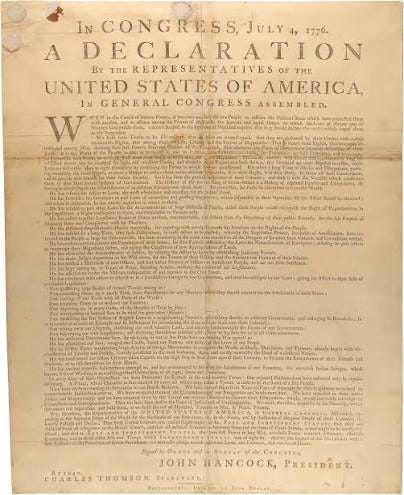
The Declaration of Independence you're picturing right now is the wrong one. The big one. The calligraphy one. The one on the tote bag, the one Nicolas Cage stole, the one with the signatures crammed at the bottom like a yearbook everybody signed at the afterparty. That's not the document. That's the souvenir. That came weeks later, made because somebody decided the moment needed to look the way it felt.
The thing that actually went out into the world was a rush job. Set in type, in the dark, on a press that men literally called the Man Killer.
A broadside is a single sheet printed on one side, meant to be read once and thrown out. The eighteenth-century version of a screenshot. You pasted it to a wall, people crowded around it, and then it got rained on or papered over or used to wrap something. Nobody who made one thought they were making a relic. That was the whole point. It was supposed to be disposable.
Here's what I mean by rush.
Congress adopted the text on July 4. The manuscript got walked straight down to a print shop on Market Street belonging to a twenty-nine-year-old named John Dunlap, and he printed through the night. Not in some romantic candlelit way. The press took one sheet at a time. You fed the paper in by hand and you cranked a heavy iron arm to slam the type down, one pull, one page, again, again, for hours. The machine was so brutal to operate that printers nicknamed it the Man Killer. That is the labor that turned a vote in Philadelphia into news. A guy my brother's age, sweating through the night, working a machine named after what it did to the body, because the country could not wait until morning. Twenty-nine, soaked through, hauling on a machine that was trying to break him, and he did it anyway. I think about him more than I think about any of the men who signed.
Dunlap almost certainly wasn't thinking about immortality. He was probably thinking about whether he had enough paper.
By the morning of July 5 the copies were already moving. They went up in public squares and galloped up the coast. One went to George Washington, who read it to his troops in New York on July 9 to inform several thousand men that they had stopped being British subjects. The copy that reached Exeter, New Hampshire on July 16 got read aloud in the street by a twenty-two-year-old. This is what people heard. Not the parchment. This.
Because the parchment did not exist yet. The engrossed version everyone worships, the one in the gold titanium case that gets lowered into a vault every night, was not even ordered until July 19 and not signed until August. Hancock's famous signature, the dramatic one, the one that became a synonym for signature? Not on the broadside. On the broadside his name is type. Cold metal letters. "Signed by Order and in Behalf of the Congress, JOHN HANCOCK, President." He didn't sign these. He didn't need to. Imagine needing the famous pen, the huge swooping autograph, the look-at-me. The broadside didn't need any of it. It walked out the door anonymous and changed the world before Hancock even picked up his quill. That's the part that wrecks me. The thing didn't need a single human hand on it to be true. It just needed to exist and to travel, and it did both before the ink on anybody's pen was wet.
Dunlap printed maybe two hundred. Twenty-six survive.
Twenty-six. Out of the document that started the country. The rest got read until they disintegrated, used to wrap other papers, pasted to walls and rained on, thrown out. Nobody saved them because nobody knew. You never know in the moment which piece of paper is the one. That's not stupidity. That's the condition of being alive inside history while it's still happening. The night it mattered most, nobody in that shop was thinking legacy. They were thinking deadline.
Then there's the one that surfaced in 1989. A man at a flea market in Adamstown, Pennsylvania bought a framed painting for four dollars. He wanted the frame. There was a tear in the backing, and folded up inside it was a Dunlap Broadside. It sold at auction for $2.42 million, and then again later for $8.14 million. A founding document of the United States, surviving two hundred years because it got jammed behind a picture nobody wanted, in the dark, waiting, while a guy carried it home for the frame.
That's the thing I can't get past. The most important object is never the beautiful one. It's the working one. The parchment is the portrait. The broadside is the person. We built a shrine around the version with the good handwriting and the signatures in a row because that version flatters us. The parchment is the one that got the credit for work it didn't do. It showed up late, gorgeous, signed by everyone, and let history hand it the trophy while the broadside, the thing that actually did the running, got used to wrap fish. It looks like how we want the founding to have looked. Deliberate, grand, great men signing in order. The broadside flatters nobody. It's tired and fast and smudged and printed by a sweating twenty-nine-year-old on a machine named for killing men, and it went out the door before anyone had time to make it pretty.
You can go see this. Not the souvenir in D.C. The real working ones. This year, for the 250th, they're out. The Museum of the American Revolution has the Jonas Phillips copy, the one a Jewish merchant down the street from Dunlap's shop folded into a letter to his cousin in Amsterdam three weeks after independence, written in Yiddish, intercepted by the British, gone for 250 years, now home. Walk a few blocks and the American Philosophical Society has theirs displayed next to the actual revolving chair Jefferson is believed to have sat in while he wrote the words Dunlap set in type. Both within stumbling distance of each other in Philadelphia right now.
Go stand in front of one. Read the type at the bottom. Think about the hands that set it, in a hurry, at night, on the Man Killer, not knowing.
The relic is the one that got worshipped.
This is the one that did the work.
Very moving essay; I loved the apposition of portrait/person and speaking of the broadside as the one that did the work.
Great story. I never thought about it. I will go see this! It's about a 30 min walk for me.