
The Revolution’s Middle Child

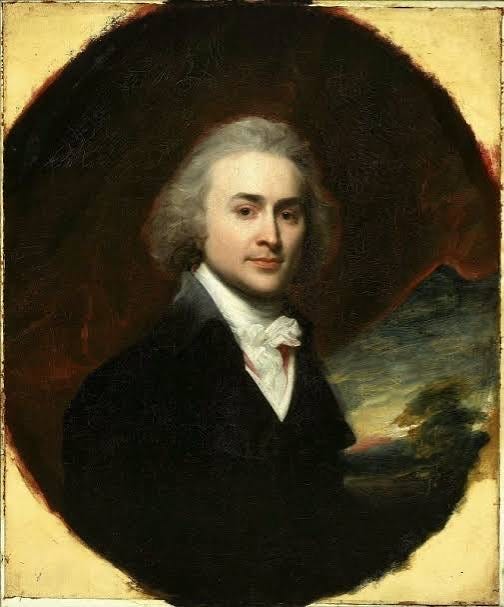
John Quincy Adams was born in 1767, which meant he was too young to sign the Declaration of Independence and old enough to watch it become real. He belonged to the generation that did not write the founding ideals but had to live inside their consequences. Not the architects. The inheritors.
He grew up in a house where liberty was not a slogan but an argument. His father, John Adams, believed republics survived only through discipline and moral seriousness. His mother, Abigail Adams, wrote letters insisting that the Revolution would be hollow if it did not expand its promises beyond property-owning men. Equality was not decorative language in that household. It was a question waiting to be answered.
He was seven when he stood with Abigail on Penn’s Hill and watched the smoke of the Battle of Bunker Hill rise into the sky. Before he understood theory, he understood cost. Before he understood constitutional language, he understood that empires burn people to preserve themselves. That lesson never left him.
The Founders declared independence in ink. John Quincy Adams grew up watching whether the ink would hold. I find that detail unbearable in the best way. Imagine knowing, even as a child, that you are living inside a promise that might fail.
He was not present at Philadelphia in 1776. He did not draft constitutions or design executive offices. What he inherited instead was something heavier: a republic that had announced equality to the world and then hesitated to define it. A nation that rejected empire while expanding west. A political experiment that spoke of liberty and tolerated slavery.
At twelve he began the diary he would keep for seventy years. In those pages you can watch him trying to reconcile principle with practice. The Revolution was not an event to him. It was a standard. And standards demand auditors. I will always be weak for a man who treats language like something binding instead of ornamental.
By ten he had crossed the Atlantic with his father on diplomatic assignment. By thirteen going on fourteen he was in Saint Petersburg serving as secretary to Francis Dana. He learned early that republics survive not on sentiment but on leverage, on treaties, on careful positioning among empires that do not care about your ideals.
He loved principle. He did not romanticize power. That combination does something to me. It is deeply inconvenient.
As Secretary of State under James Monroe, he shaped the republic’s external posture in ways that quietly defined the century. The Adams–Onís Treaty secured Florida and drew a continental boundary to the Pacific. A republic that cannot define its borders cannot defend its ideals.
Then the Monroe Doctrine. Monroe announced it. Adams built it.
When he argued that European powers must not recolonize the Western Hemisphere, he was extending the logic of 1776. If sovereignty meant anything, it meant that empire could not simply rebrand and return. The Revolution, in his mind, had geographic consequences. Independence required perimeter.
There is a straight line from the boy who watched artillery at seven to the statesman who locks the hemisphere against imperial intrusion. That kind of coherence is not accidental. It is psychological. It is ideological. It is almost severe.
In 1821 he said America goes not abroad in search of monsters to destroy. What he meant was that power without restraint becomes empire wearing new clothes. He had seen what appetite does to maps. He did not want the republic to become the thing it once resisted. That level of self-control, in a political culture that rewards aggression, feels radical even now.
Then he became president and discovered that brilliance does not guarantee affection.
The election of 1824 fractured and was thrown to the House. He prevailed over Andrew Jackson, and accusations of a corrupt bargain hardened into identity. Adams entered office believing that competence and vision should persuade. Democracy gently informed him that vibes matter.
He proposed roads, canals, a national observatory, a university. He wanted a republic that invested in knowledge, that took its own longevity seriously. Congress blocked much of it, not because the ideas were unserious but because denying him victory was politically useful.
He knew he lacked charm. He wrote about it. He did not attempt to simulate it. Before dawn he swam naked in the Potomac and recorded the temperature in his diary, then returned to preside over a government that did not particularly love him. It reads almost monastic. Almost defiant. There is something about a man who chooses principle over popularity that feels both admirable and socially catastrophic.
When he lost reelection, he did not retire. He ran for the House of Representatives and won. Seventeen years.
This is where the middle child stops asking for approval and starts auditing the family.
The gag rule automatically tabled anti-slavery petitions without debate. Adams treated this as constitutional rot. If citizens could not petition their government, what exactly had the Revolution secured?
Day after day he rose and forced petitions into the record. From women. From abolition societies. From free Black Americans. He was censured. He survived it. He widened the argument instead of retreating. The older he became, the less patience he had for moral evasions. I cannot stress enough how destabilizing that is as a character trait.
In 1841, at seventy-three, he stood before the Supreme Court in the Amistad case. Over two sessions he spoke for nearly eight hours defending the Africans who had revolted aboard a Spanish slave ship. He pointed to the Declaration of Independence and insisted that its language was not ceremonial but binding.
He treated the Revolution like a contract you could drag back into court and force to answer for itself.
The Court ruled in favor of the captives.
That is not accidental heroism. That is ideological consistency stretched across a lifetime.
On February 21, 1848, after voting against the Mexican-American War, which he believed would expand slave territory under the banner of destiny, he rose to answer a question and collapsed on the House floor. He died two days later in the Capitol.
He did not soften into myth. He did not retreat into memoir. He died mid-argument.
Historians call him an average president and one of the greatest diplomats in American history. That split judgment feels almost poetic. He was never built for applause. He was built for endurance. For correction. For insisting that the republic mean what it says.
The Founders built the house.
John Quincy Adams walked its hallways long after they were gone, candle in one hand, ledger in the other, measuring the distance between language and reality. He refused to let promises become decorative.
And if I am honest, I find that level of relentless moral accounting almost unbearably compelling.
That is the work of the middle child.
And he carried it until he physically could not rise again.
I feel like I knew a ton about John Quincy Adams but after reading this wonderfully written article, I learned so much more. Thanks.
The way you write is so descriptive, and really paints a clear picture of the topic for your readers. It’s so easy to follow, and the personal asides almost make it feel like a conversation. Like we are part of the story you are telling.