
The Cinderella Family Tree


Still from Cinderella (1950).
© Walt Disney Productions.
You know this one. Blue dress, glass slipper, pumpkin, mice with names, a curfew. A girl so relentlessly pleasant that her entire personality is not complaining. She sings while she scrubs, she befriends vermin, she gets a makeover from a woman who materializes out of nowhere because being sad in a garden is apparently a summoning ritual. Then she goes to a party, loses a shoe, gets found. Reward for good behavior. Girl gets prince because girl was nice.
You'll find that one on the lunchbox, the ice rink, the birthday cake, the Halloween costume, the Broadway stage, and the direct-to-video sequel where the mice have a subplot. It's been reproduced so many times it functions as the original in most people's heads.
It isn't. There is no original, and the hunt for one gets embarrassing fast.
There's a Chinese version from around 850, written down by a man named Duan Chengshi, where a girl called Ye Xian gets her golden shoes out of the remains of a fish. Her fish. She kept it, she loved it, and her stepmother found out, killed it, and ate it. The bones kept working for her anyway. That's roughly a thousand years before Disney and it already has the shoe, the festival, and the disturbing habit these stories have of making dead things keep providing.
There's an Italian one from 1634, Neapolitan, by Giambattista Basile, and I want you to sit down for this one. His heroine is named Zezolla, and in the first act she murders her stepmother. Her governess talks her into it, because the governess wants to marry the father. Zezolla does it. The governess marries the father, brings in her own six daughters, and things get considerably worse. Then the new family demotes her to the kitchen and starts calling her Cenerentola.
Basile didn't reach German until 1846, and Jacob Grimm wrote the introduction to it. By then the brothers had spent decades presenting these stories as evidence of a German popular tradition, and here was an alarming number of familiar plots already sitting in a Neapolitan book printed two centuries before they were born.
So there is no original. There's a family, old and unruly, and nobody gets to stand at the head of it. What we have are versions, and two of them became canonical. Only one supplied the furniture everybody remembers. One is French and one is German and they want completely different things from the same set of bones.
In the other one, she goes out three nights running, dressed better each time, and lets a man chase her through a garden without ever telling him her name.
Let's back up.
The German one is called Aschenputtel. No fairy godmother in it, no wand, no bibbidi anything. And her father is alive. Present. In the house. Not dead, not cursed, not lost at sea. Just there, all the way through, watching.
It opens with a woman dying. She calls her daughter to the bed, tells her to stay good and pious, and dies. The father remarries inside a year, and the new wife arrives with two daughters of her own, beautiful in the face and vile underneath, and they take the girl's clothes and her bed and put her in the kitchen to sleep by the hearth in the ashes.
Then they name her for it.
Asche is ash, and the rest of it is a dialect word for a filthy girl, and the sisters hand it to her as a taunt. Cendrillon in French, Cinderella in English, all of it the same joke about what she smells like now. The story never tells you what her name was before. She had one. Some woman named her, then died, and her daughter's real name is not in the text and no version has ever gone looking for it. What we call her is what the people who ruined her life called her, and it stuck so hard that three hundred years later it's on the merchandise.
The tree comes first, and nobody ever repeats this bit.
Before any of the festival business, the father goes to a fair and asks the girls what they want him to bring back. The stepsisters want dresses and pearls. Aschenputtel asks for the first branch that hits his hat on the way home.
A branch. She asks her father for a stick.
The text never explains it. Her sisters name real objects, the kind of thing you'd actually want from a man going to a fair, and this child asks for whatever piece of tree happens to smack him in the face on the road. She doesn't ask for a dress. She doesn't ask for food, or shoes, or to be treated like a daughter. She asks for something he cannot fail to bring back, because it costs nothing and requires no thought and he'd have to actively refuse to hand her a twig.
Read it as a girl who already knows exactly how much her father is good for and calibrated the request accordingly. Read it as a girl who has been to the grave enough times to know what she wants to plant there. The Grimms don't say. They just report the request like it's a normal thing for a kid to want, and then everything in the rest of the story comes out of that stick.
She plants it on her mother's grave and waters it with her tears until it becomes a hazel tree, and a white bird comes to it, and that bird gives her everything she gets in this story.
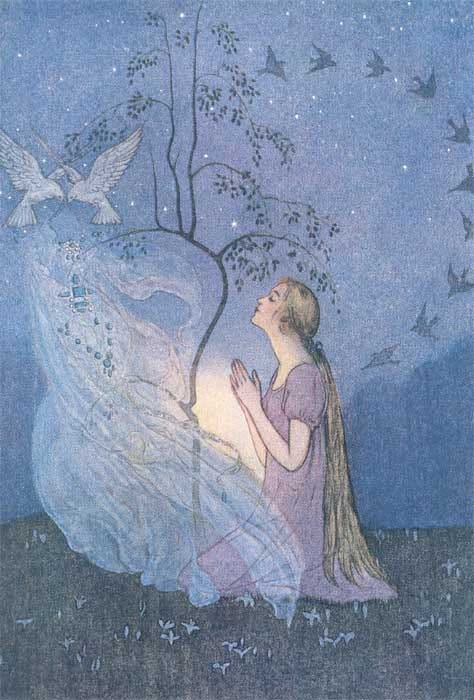
Aschenputtel praying at her mother’s grave
Illustration by Anne Anderson, from Grimm’s Fairy Tales (c. 1920).
The magic isn't a nice lady who shows up because you were patient. It's her dead mother, in the dirt, converted into a tree by years of a child crying on it. She didn't get rescued. She grew her own supply line, she maintained it for years, and she's the only person in this story with an actual plan.
Nobody in this text says she is cruel. Her mother told her to be good and pious and she is, all the way through. But nice isn't what saves her. What actually gets her out of that house is a request she made as a child, a tree she planted herself, and three nights of outrunning a man who wanted to catch her. The patience is real. It just isn't the machinery.
It goes missing later. Somewhere between this girl and the one everybody can describe, the waiting stopped being what she does while she works and became the reason she wins.
Now the festival, which Disney cut down to one night.
The king announces three days of it so his son can pick a wife, and every girl in the kingdom is invited. The stepmother tells Aschenputtel she can go if she picks a bowl of lentils out of the ashes in an hour. She calls the birds and they do it. The stepmother doubles the lentils and halves the time. The birds do that too. Then the stepmother takes her daughters and leaves without her anyway. The tasks were never a test. They were a way to make the girl participate in her own exclusion.
So she goes by herself. Three days.
Disney gives you one night, one dress, and a woman who shows up to hand it over. Fine. Efficient. But watch what gets lost. Every night she goes to the tree and asks it to shake gold and silver down over her, and every night the dress is better than the last, and on the third it's so far past the others that the entire room goes silent when she walks in. Silver and silk on night one. Gold by the end. Nobody recognizes her. Her own family stands there assuming she's a foreign princess, because it does not occur to any of them that the girl in the ashes could be in the room.
And the prince does not leave her side. He dances with her and nobody else. Every time another man comes over to ask, he says she's his partner. He doesn't let go of her hand all night. Three nights of a man refusing to look at anyone else in a room full of women who came specifically to be looked at.
Then she leaves. Every single night, she leaves, and she decides when.
There's no clock in this story. No midnight, no curfew, no spell wearing off. She goes when she's tired, and she goes because she has to be back in the ashes before her family walks in the door. She isn't fleeing him. She's protecting the arrangement, because a girl who gets caught coming home in gold has nothing left, and the tree is the only thing she owns.
So he goes after her, and she is faster than he is. Night one she jumps into the pigeon coop. Night two she climbs a pear tree, up into the branches like a squirrel, and sits there while he stands underneath not knowing where she went.
And where she's running to is her own house. She isn't escaping into the countryside, she's sprinting home to beat her family back, so the prince chasing her ends up standing in her father's garden both nights, watching a girl in gold disappear into the outbuildings of a house he now knows the location of.
And then her father comes home from the same party and finds a prince in his yard.
The prince doesn't search either one himself. He tells the man who owns the property that a girl got away from him and went in there, and lets him handle it. Both nights.
Night one the father sends for an ax and a pick and breaks the pigeon coop apart. Night two he has an ax brought and cuts the pear tree down. Not opens. Not searches. Destroys, twice, on his own property, at the suggestion of a man he's trying to impress.
And the text tells you what he's thinking while he does it. Could it be Aschenputtel?
He suspects. Both times, he suspects it's her, and he takes an ax to the thing she's hiding in anyway. This is a man who will demolish a building on the chance that his daughter is inside it, and who will not, at any point across three days, walk into his own kitchen and ask her where she's been.
Then the prince comes to the door with the shoe and asks if there's another daughter in the house and the father says no.
Not maybe. Not she couldn't possibly. He says no, and then adds that there's only a deformed little thing left over from his first wife who cannot possibly be the bride.
He chopped down a tree looking for her and then denied she existed. Both of those are the same sentence about the same man. He suspected she was the mystery girl strongly enough to wreck his own garden, and when the answer arrived at his door in the shape of a prince, he wanted the credit to go to somebody prettier.
Anyway. Back to the stairs.
By the third night the prince is done being outrun, so he tars the staircase. Smears the entire thing with pitch before she gets there. And she runs anyway, straight down it, and her left shoe sticks and stays behind and she keeps going without it.
He got a shoe. That is the entire haul. Three nights of undivided attention from the most beautiful woman in the kingdom, and what he ends up with is footwear he had to set a trap to acquire.
He then announces he'll marry whoever the shoe fits, which means he spent three nights holding a woman's hand and could not identify her by anything above the ankle. Imagine explaining that policy out loud. Imagine the staff meeting.
Remember that when we get to the sisters.
In a story where a man measures women by their feet, the women figure it out.
The eldest can't get her big toe in. Her mother, the stepmother, the one who put Aschenputtel in the ashes, hands her a knife and tells her to cut off the toe, because when you're queen you won't have to walk anywhere.
Nobody writes a villain line like that. It's career advice. She looks at the marriage market, does the math, and concludes a toe is a reasonable price for a crown. She understands exactly how brutal that market is, which is the horrible part, because she's the only living adult in the story who's read the room correctly.
And the girl does it. Cuts off her toe, forces her foot in, swallows the pain, walks out smiling. Not a word of protest in the text. She takes the knife like it's a reasonable ask, which, in that house, on that morning, it is.
He puts her on his horse and rides off with her as his bride.
He does not look at her face.
They pass the grave, the pigeons start yelling that there's blood in the shoe and this bride isn't right, and only then, only after a bird tells him, does he look down and notice his fiancée is hemorrhaging into her footwear.
He turns around, drops her off, asks for the next one.
Second sister. Cuts off her heel. Same knife, same stepmother, same shoe, fresh from carrying the first sister's blood. She gets on the horse. He rides off with her. Same tree, same birds, same rhyme, same U-turn.
Twice. He does this twice. Our romantic lead, the prize, the entire justification for calling this a happy ending, rides off with two separate mutilated strangers because he was verifying a shoe size and couldn't be bothered to raise his eyes twelve inches.
Then he comes back a third time and asks about other daughters, and you already know what the father says.
The stepmother tries it too. When the prince insists on seeing her anyway, she says the girl is much too dirty to be looked at, which is a remarkable thing to say about a condition you personally engineered. Two adults in that house, both working to keep her out of the room, both of them out of excuses.
Everyone remembers the evil stepmother. Nobody remembers that dad was home the whole time and picked a side.
She washes her own hands and face first. Nobody helps her do it. Then she tries the shoe, and it fits, obviously, because it's hers, because a bird made it. And the prince looks into her face, and only then does he recognize the woman whose hand he held for three nights.
Now the wedding.
The stepsisters show up, because there's proximity to power on offer and they've already put a toe and a heel into this. Aschenputtel lets them in. No speech about it, no scene at the door. She puts them in her procession, one on her right and one on her left.
The pigeons take one eye from each on the way to the church.
They take the other two on the way back.
The Grimms report this like a weather update. No gloating, no moral, nobody in the text finds it worth commenting on. Two women who cut their own bodies apart trying to marry up get blinded in installments, in public, at a wedding, by a dead woman's birds. Then the story stops.
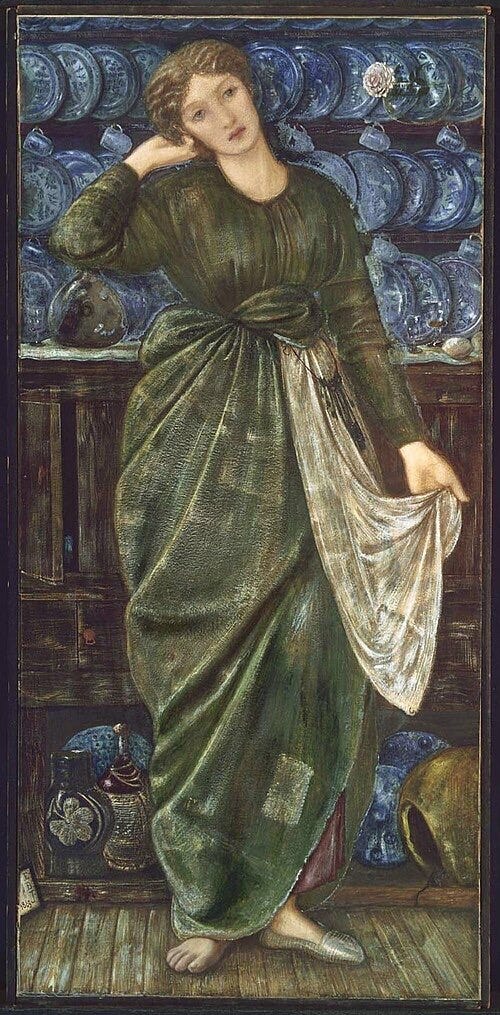
Eleanor Fortescue-Brickdale, Cinderella (1906).
Oil on canvas. Private collection.
So who decided you'd get the mice instead?
Charles Perrault, who had a day job. He spent his career inside Louis XIV's government, doing government things, and then in his late sixties he published a slim book of fairy tales that turned out to be the most durable thing he ever did. Sleeping Beauty is in there. Little Red Riding Hood, Puss in Boots, Bluebeard. And Cendrillon, with the pumpkin and the godmother and the glass.
That was 1697, which beats the Grimms by more than a century, so nobody sanitized anybody. Perrault was dead a hundred and nine years before their first volume existed.
His version ends with a moral in verse, because he did not trust you. His Cinderella forgives the stepsisters and marries them off to noblemen, and the lesson is that a woman's best asset is being lovely about it when people hurt her.
Then he writes a second moral, which nobody ever quotes, and it's the funniest thing either of these men ever did. Intelligence, courage, good breeding, common sense, he says. Wonderful. Excellent. Won't get you anywhere without a godfather or a godmother to put in a word for you.
That's a career bureaucrat at Versailles telling on his entire world. Be gracious and be beautiful, sure, and also know somebody. The fairy godmother was never magic. She's a connection. She's the aunt who knows the admissions officer, and she is arriving in a coach.
So why two versions at all? Because the two operations had nothing to do with each other.
Perrault was writing literature for the cultivated set he ran with, where fairy tales were already fashionable, largely thanks to women writing them. He took stories that were floating around and dressed them for that room.
The Grimms were doing salvage, or thought they were. Jacob and Wilhelm were philologists working during and after the Napoleonic wars, when arguing that there was a German culture worth having was a political act, and they went looking for it in what people said. First volume 1812. Then they kept revising it for forty-five years across seven editions while Wilhelm quietly made the prose nicer and more Christian, which is a thing collectors do when they realize mothers are buying the book. Their sources were mostly educated women they knew socially, not peasants at a hearth. It is not a transcript of anything.
But they were treating the material as an inheritance rather than a product, and the version they kept has the grave in it. And the knife. And the blood, and the birds.
Disney adapted Perrault.
So the Cinderella every kid in America can draw from memory is one French bureaucrat's opinion about how women should behave when someone hurts them, run through an animation studio in 1950 and sold back to us as a story about being nice.
The curfew is his too. In Grimm she leaves when she's ready and outruns him three nights running. In Perrault she has to be home by midnight or the magic quits, and Disney built an entire clock tower sequence out of it, all that panic on the steps, the shoe coming off because she's running out of time rather than because a man tarred the stairs. One version has a woman deciding when the night ends. The other has a deadline imposed on her by the same magic that dressed her, and generations of girls have been handed that one as the romantic version.
The German one wants completely different things. It wants you to know a dead woman can keep feeding her daughter from underground, and that it takes years, and that the girl pays for it in tears, by the bucket, out on the grass. It wants you to notice that a man can hold a woman's hand for three nights and still trust a shoe over her face. And it thinks the marriage market is vicious enough that a stepmother will hand over a knife and call it good sense, which is the one piece of advice in the whole story nobody argues with, including the daughter holding the blade.
Those are two different mothers, and the story knows exactly what it's doing by putting them in the same house. One is dead and still feeding her child. The other is alive and cutting hers apart for a better address.
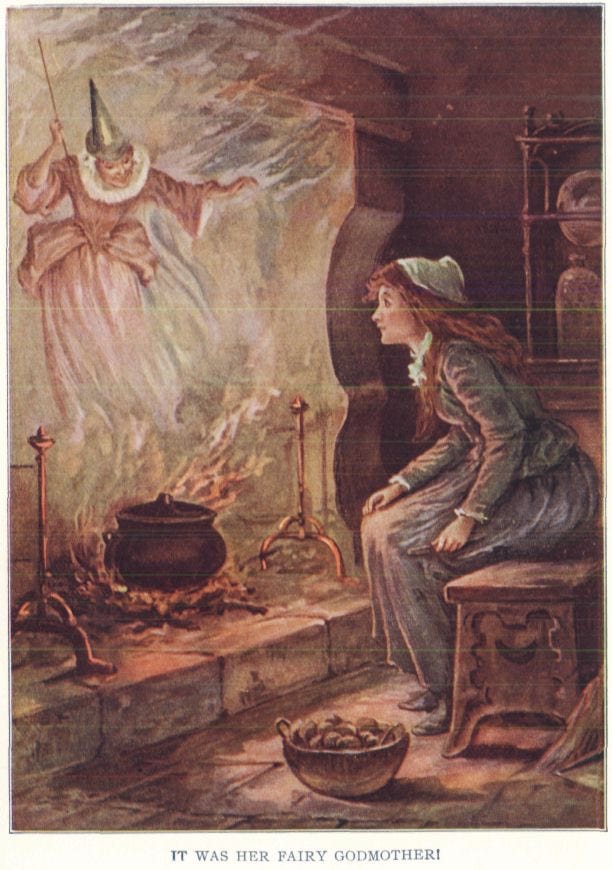
“It Was Her Fairy Godmother!”
Illustration by John Hassall, from Cinderella (Blackie & Son, c. 1910).
The Grimm version never went anywhere. It stayed in print, crossed languages, sat on shelves next to the other one. But when publishers and illustrators and theaters and eventually filmmakers went looking for a Cinderella they could reproduce, they kept reaching for Perrault's furniture. The pumpkin, the godmother, the glass, the clock. By the time Disney was done in 1950, none of that felt like one man's choices anymore. It felt like the story.
So the waiting became the point. Take away the tree she planted and hand her a godmother who arrives on her own. Take away three nights of outrunning him and give her a curfew. Take away the girl who asked for a branch because she already knew what her father was worth. What's left is a girl sitting in a kitchen being pleasant until someone notices, which is a description of the character most people can give you off the top of their head.
Both versions are about a girl trying to survive her family. Only one tells you what that costs.
He held her hand for three nights and still couldn't pick her out of a lineup. The only reason he ever found her is that a bird told him to check the shoe for blood.
And the mother never gets up. She's in the ground for the entire story, and she's the only one in it who does a single thing.
can I steal this? i teach at a girl's high school...
This is more to the legend than I was aware of. It appears that Walt Disney and Company did the multiple cutting paste operation to create the story that they told to the world in animation. Thank you, Emma for giving us the real story(s). 🙌