
Hot Girl CliffNotes: Hamlet

Everyone has been taught the wrong play.
The Hamlet you got in school is a meditation on indecision. A noble prince paralyzed by thought, suffering beautifully in iambic pentameter, asking the great philosophical question of whether to be or not to be. This is the version your English teacher could safely teach to a room of sixteen-year-olds without anyone’s parents calling the school.
That play does not exist.
The actual play is about a son who screams at his mother for fucking, who drives his girlfriend to drown herself, who kills the wrong man through a curtain, who has two of his college friends executed by forged letter, and whose great philosophical contribution to the canon is a speech he gives to himself in a hallway about whether to kill himself. The famous delay is not philosophical. The famous delay is a tantrum dressed in iambic pentameter. Hamlet is not a hero of indecision. He is what happens when a man cannot tolerate the existence of his mother’s sex life and turns the entire kingdom of Denmark into the staging ground for his refusal to deal with it.
Here is what is actually inside the play.
The ghost of Hamlet’s father, the old king of Denmark, appears on the battlements at Elsinore and tells his son that his uncle Claudius murdered him by pouring poison in his ear while he slept in the garden, then took his crown and married his wife inside of two months. The poison entered through the ear and curdled his blood and killed him. The ear is where it starts. The play will not stop coming back to ears, to what gets poured into them, to what they hear and what they let in. Hamlet is asked, by this ear-poisoned father, to please get revenge. He says yes. Then he spends four and a half acts not doing it. By the end of the play eight people are dead, including his mother Gertrude, his girlfriend Ophelia, her father Polonius (the king’s chief advisor), her brother Laertes, two college friends he had executed in England, Claudius himself, and finally Hamlet. A Norwegian prince named Fortinbras, whose own father Hamlet’s father killed in a border war years earlier, walks in and inherits Denmark like he’s picking up a package.
This is the most famous play in English. It has been performed continuously somewhere on earth for more than four hundred years. What’s inside it is rot.
And Shakespeare knew. Shakespeare wrote it that way on purpose. The revenge tragedy was already a genre when he wrote *Hamlet*. There were rules. A ghost shows up, names the crime, demands blood, the avenger goes mad either really or strategically, kills the killer, dies. Audiences in 1600 had seen this play. They’d seen Kyd’s *Spanish Tragedy*. They knew the moves. Shakespeare’s move is to write a revenge tragedy where the avenger refuses to perform the genre. Hamlet stalls. He hires a traveling acting company to stage a play that re-enacts the murder, planning to watch Claudius’s face for a flinch. Claudius flinches. The proof is in. Hamlet then finds him alone in a chapel literally on his knees and decides not to kill him *because the man is praying and might go to heaven*. The killing, when it finally happens in the last sixty seconds of the play, is unplanned and reactive and only happens because Hamlet himself is already dying from poison. The revenge plot is a structure he keeps failing to enter, and so the structure rots from the inside while he’s standing in it.
The thing he does instead of killing his uncle is talk. He talks to the ghost, to himself, to the air, to a skull, to Rosencrantz and Guildenstern (two old school friends Claudius has hired to spy on him, who he does not trust), to Ophelia (the girlfriend he humiliates), to Gertrude (the mother he cannot stop looking at). The talking is what the world reads as madness, and the world is wrong, and the world has been wrong on purpose for four hundred years because reading the talking as madness lets everyone off the hook. He announces in act one that he will fake being insane. He calls it an “antic disposition.” Then he proceeds to behave so unhingedly for the rest of the play that scholars have argued for four hundred years about whether the fake madness became real madness or whether he was just always like this. The trick is that you cannot tell. He’s grieving (his father is two months dead), he’s been visited by a ghost, his mother has remarried the murderer, his girlfriend has been weaponized against him by her father Polonius (who has instructed her to break off contact and then helps Claudius eavesdrop on their conversations), and he is in his twenties in a court where every adult is lying to him. He’d be coming apart without the ghost. The ghost just gives the coming-apart a vocabulary. The poison entered through the ear and what comes out of Hamlet’s mouth for the rest of the play is what the poison made.

The play knows the difference between the man who talks too much and the woman who actually loses her mind. Hamlet performs madness in language, in puns and wordplay and forty-line soliloquies that he gets to finish. Ophelia loses her mind for real, and the trigger is specific: Hamlet kills her father. After Polonius’s death her madness comes out as songs and fragments and flowers she hands to people with no context. Rosemary for remembrance. Pansies for thoughts. Fennel, columbines, rue. The flowers have meanings she does not have to speak aloud, and she gives them to the king and queen and to Laertes, the brother who is about to try to kill the man who drove her mad. Then she drowns. The play gives the man the words and the woman the silence and then the river. And the part nobody tells you in school, which every English teacher in America has decided you are not ready for, is that the songs Ophelia sings before she drowns are bawdier than anything Hamlet says. She sings about a girl who lost her virginity to a man who promised to marry her and then didn’t. She sings it to the queen. She sings it in front of her brother. Ophelia goes mad and her madness comes out as sex, which is what her madness was about in the first place, because the play she has been living inside has been about female sexuality from the moment the ghost named his brother’s marriage incestuous, in act one, scene five, while she was offstage.
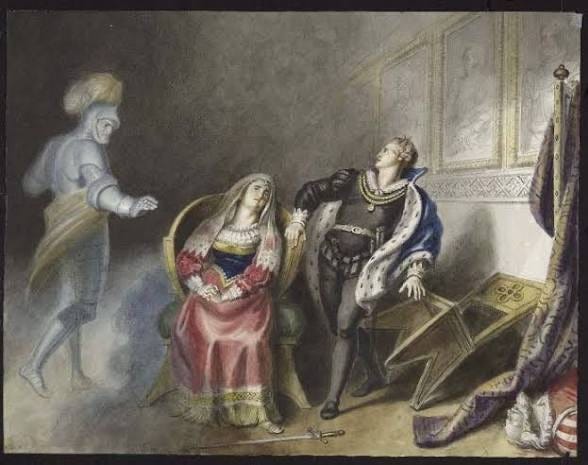
That’s the other thing the play cannot let go of and the curriculum has decided to skip. Gertrude marries her dead husband’s brother. Under the canon law of the period, this was incest, full stop. Henry VIII had used exactly this argument to annul his marriage to Catherine of Aragon sixty years before Shakespeare wrote the play. The ghost calls the marriage “incestuous” with his second mouthful of language. Hamlet calls it incestuous. Claudius does not deny that it’s incestuous. He just acts like everyone should move on. The play will not move on. It stages the bedroom scene. It puts Hamlet and Gertrude alone in that room for nearly four hundred lines. He screams at her for being a woman who likes sex. He compares his father to a god and his uncle to a satyr. He tells her in detail what she does in bed with Claudius, “the rank sweat of an enseamed bed, stewed in corruption, honeying and making love over the nasty sty.” This is a son talking to his mother. The scene is so charged that the ghost shows up in the middle of it to redirect his son. The ghost, who is dead, intervenes to protect Gertrude from her own son’s mouth. And in the middle of all of it Hamlet kills Polonius, who has hidden behind a curtain in the bedroom to eavesdrop, stabbing him through the fabric without knowing who is back there. The bedroom is already a place where men die. The bedroom and the garden and the ear: every place a body becomes vulnerable in this play, the play returns to.
The play stages it because the play wants you in the room. You are watching a son who cannot stop talking about his mother’s bed and you can feel the play knowing it. Freud read this and wrote the Oedipus complex, and Freud is not always right but he read this play correctly, which is more than can be said for the high school sophomores who get this play taught to them as a meditation on indecision. The thing Hamlet cannot do is not just kill Claudius. It is accept that his mother is a person who fucks. He’d rather she be a saint or a whore. She is neither. She’s a widow who got remarried fast and the play does not tell us why. It might be love or politics or the fact that Claudius is, on paper, a better king than her first husband. We don’t know. Hamlet doesn’t ask. The play lets her stay opaque, and the opacity is its own kind of rot, because what cannot be looked at directly is what ends up running the room.
What it runs is death. The bedroom is overheated because the whole play is being spoken from inside a world where the ghost already arrived in the first scene. Death is in the castle before anyone says a word. The most famous speech in English is Hamlet’s, in act three, about whether to kill himself, and somehow a suicide soliloquy has become the most quoted line in the language, recited by people who would not finish the play if you paid them. The skull scene, where Hamlet picks up the skull of Yorick, the court jester who used to carry him on his back when he was a child, in the cemetery where Ophelia is about to be buried, is the moment the play stops pretending it’s about anything else. The jester is now a thing with no lips. “Where be your gibes now? Your gambols? Your songs?” Gone. The skull is the punchline of every conversation that came before it. By the time Hamlet is holding it the play has been telling you for four hours that this is where every mouth ends up. The gravedigger is digging Ophelia’s grave while joking about how long a corpse lasts in the ground. Polonius is already dead behind a curtain. Rosencrantz and Guildenstern have been executed in England without ever appearing onstage to die, killed by a forged letter Hamlet wrote substituting their names for his. Ophelia is in the ground. The body count is so high that by the final scene, in which Laertes and Hamlet duel with poisoned blades and Gertrude drinks from a poisoned cup meant for her son and Claudius is finally stabbed and forced to drink from the same cup, Fortinbras has to step over corpses to claim the throne. What the play does with all of it is refuse to make it mean anything. People die badly and for nothing and the survivors give speeches about it that don’t help. Hamlet’s last words are about who should rule Denmark next, which is a question the play has barely cared about for four hours. And then: “the rest is silence.” Which is either the most profound line ever written or a man who has finally stopped speaking into his own ear.
*Hamlet* is not a play about a prince who couldn’t make up his mind. That’s the reduction. The reduction is what gets put on the AP exam, what lets a suicide soliloquy stand in for the four hours of play around it that explain why the soliloquy exists in the first place, what makes a play about a son who cannot survive his mother’s bed into a play about a thinking man. It is a lie, and it has been a lie for a long time. It is a play about what it feels like to know what the world expects of you, to agree that the world is right, and to discover that knowing and agreeing are not the same as being able to move. He talks because talking is the only thing his body will let him do. The poison entered through the father’s ear in act one. By act five it has gone through everyone in the castle.
He’s in his twenties. Everyone he loves is dead by the end. He never gets to grow up.
The poison is still in the room.
Hamlet
Stanley J Sharpless
----------
Prince Hamlet thought Uncle a traitor
For having it off with his Mater;
Revenge Dad or not?
That’s the gist of the plot,
And he did – nine soliloquies later
WOW Fantastic analysis!!!!