
Benjamin Franklin Wrote His Own Label. You Are Still Reading It.

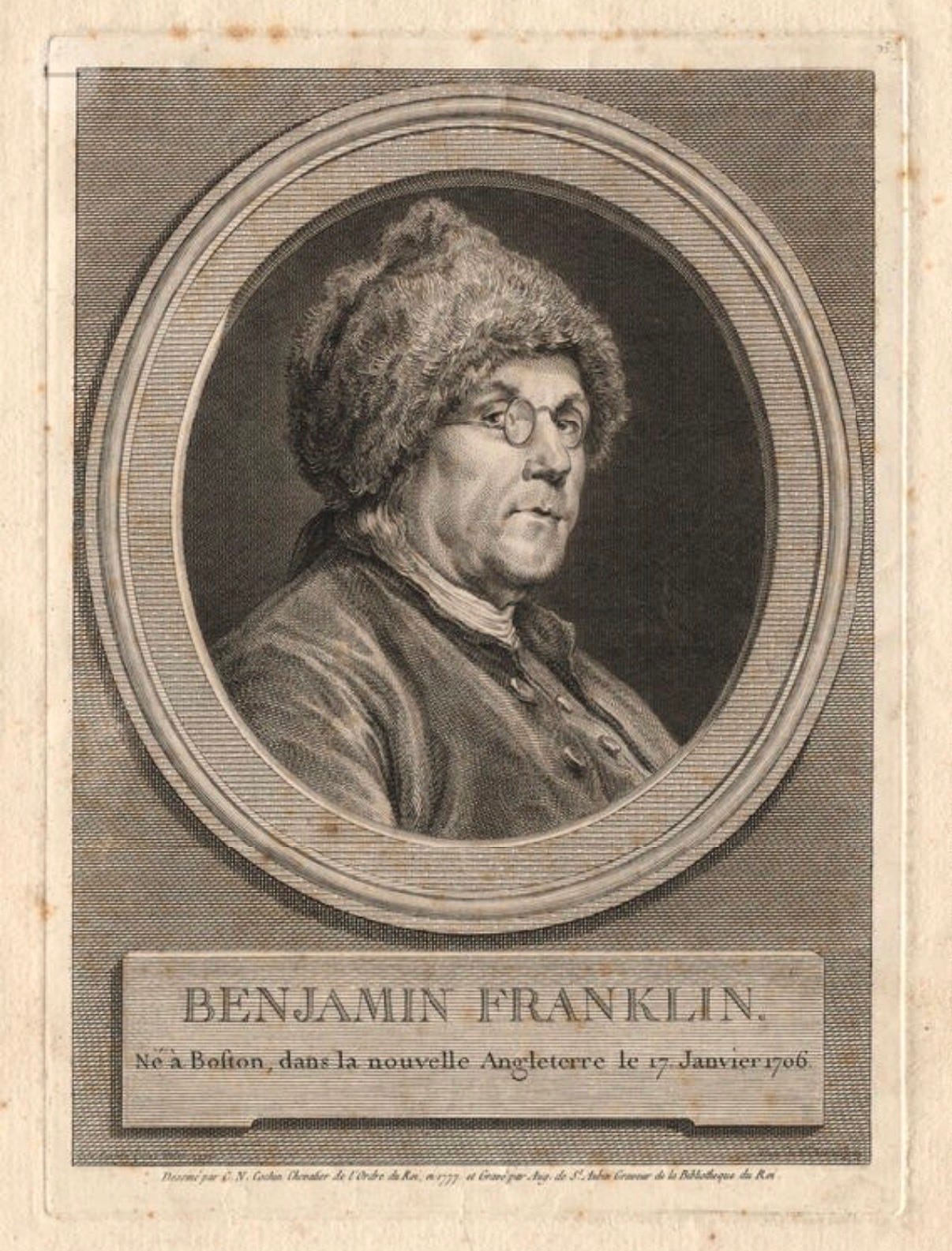
In 1777, a French engraver named Charles-Nicolas Cochin produced a portrait of a 71-year-old man in a fur cap. The cap was marten, plain, pulled down almost to his spectacles. No wig. No lace. The prints sold so fast in Paris that the sitter joked his face was as well known as the moon's. Women had their hair done "à la Franklin," teased up to imitate the cap, which means that for a season in Paris, the fashion capital of the known world, the reigning beauty reference was a 71-year-old man from Boston. Sit with that. A fur cap outperformed every milliner in France, and the man under it wrote to a friend in London, delighted, describing his own look in detail: the thin gray hair peeping out, the spectacles, the plainness of it all.
Read that again. He described his own costume. Because that is what it was, and he knew it, and he was thrilled about it.
The man in the fur cap was living in a borrowed mansion in Passy with a wine cellar that inventoried at over a thousand bottles. He had spent most of the previous two decades in London drawing rooms. He owned silk. He knew exactly what a French salon expected an American philosopher to look like, so he put on the cap and let Paris do the rest.
The cap itself is gone, which feels right. Franklin left the image and kept the trick. The image is on medallions, snuffboxes, prints, and eventually your hundred dollar bill. He was a printer. He did not have to wait for posterity to start making copies.
For 250 years we have been reading the label he wrote for his own case. That is not a scandal. It might be the best thing he ever made. But the man underneath is stranger and funnier, and I want to look at him.
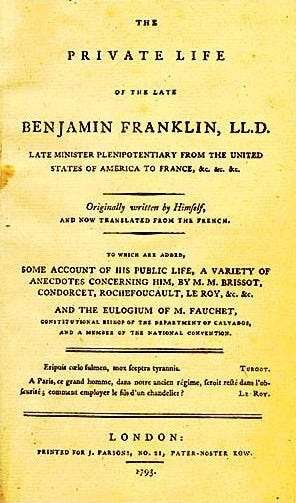
Start with the Autobiography. Franklin began it in 1771 as a letter to his son William, and it is the source of nearly everything you think you know: the runaway apprentice, the rolls of bread under his arms in Philadelphia, the thirteen virtues, the self-made tradesman rising by industry and frugality.
When Franklin confesses his sins in the Autobiography, he calls them "errata." Printer's errors. A typo is not a sin. A typo is something that happened to the text, regrettable, correctable in the next edition, nobody's fault really. Abandoning his fiancée for eighteen months while he ran around London? Erratum. Trying to seduce his best friend's mistress? Erratum. He is not asking for absolution. He is issuing a corrected proof, and honestly, respect.
Even the famous thirteen virtues come with a wink most readers miss. The thirteenth, Humility, was not on his original list. A Quaker friend told him he was insufferably proud, so he added it, with the instruction "Imitate Jesus and Socrates," which is not a humble sentence. Franklin then admitted in writing that he never actually acquired the virtue, only "the appearance of it," and that if he ever did conquer his pride, he would probably be proud of his humility. The confession happens inside the con, and it reads as charm. It still does. I am charmed right now.
About the industry and frugality. The arithmetic goes: penniless boy arrives in Philadelphia in 1723, works hard, retires rich at 42, then devotes himself to science and the public good. Early to bed and early to rise. Except the shop that made retirement possible ran on more hands than his. Deborah Read Franklin, his common-law wife, common-law because her first husband had vanished into the West Indies and nobody could prove he was dead, which is its own essay, ran the retail counter and kept the accounts, and when he became postmaster she ran that too, all while he attended the Junto and improved his mind. When he sailed to London in 1757, and again in 1764, Deborah ran his entire American life in his absence. She defended their house with a gun during the Stamp Act riots while he was an ocean away misjudging the politics. She wrote for years asking him to come home. She had a stroke, and her letters got smaller and sadder, and he stayed. She died in December 1774 without having seen her husband in ten years. Every great personal brand has an ops person nobody thanks in the acceptance speech. Hers was a marriage.
He owned people, too. Peter, King, Jemima, George. For decades, and the Gazette ran the ads, because that was standard revenue for a colonial printer and on this he was entirely a man of his century for most of his life. Then, in his eighties, the turn: president of the Pennsylvania Abolition Society, and in February 1790, two months before his death, a signed petition asking the first Congress to end slavery. When a Georgia congressman defended the institution on the House floor, Franklin's last published essay, written under a fake Algerian name, satirized the speech by having a Muslim pirate use identical logic to justify enslaving Christians. The last thing he ever published was a hoax aimed at slavery. Most of his generation never made that turn at all. He made it late, and he made it in print, which was where Franklin always knew how to make himself dangerous.
For most of his life, Franklin was not trying to leave the British Empire. He was trying to run it better. He proposed colonial union in 1754 to strengthen the empire, not resist it. He spent the 1760s lobbying to bring Pennsylvania closer to the Crown, and he misread the Stamp Act so badly that he nominated a friend to be a stamp officer, and Philadelphians nearly burned his house down. Deborah, again, with the gun.
What flipped him was one very bad afternoon. On January 29, 1774, Franklin stood silent in a London amphitheater called the Cockpit while the solicitor general spent an hour publicly shredding him in front of a laughing audience of lords. He went into that room a loyal servant of empire. He left it a lot easier to imagine in Philadelphia than in Whitehall. There is a story, probably too good to be fully true, that he kept the suit he was humiliated in, a figured Manchester velvet, and put it back on four years later to sign the treaty of alliance with France. A revenge outfit with a four-year lead time. Most people cannot commit to a lip color that long. He never confirmed the story. He never denied it either, because he understood better than anyone that the outfit was the point. This is the pettiest possible origin for a superpower and I think we should celebrate it more.
Then there is Paris, which the textbooks handle with a cough and a change of subject, and which I refuse to.
Franklin arrived in France in December 1776. He was seventy and half crippled by gout, and he was pulling. Madame Brillon, a brilliant composer in her thirties, sat on his lap, called him "cher papa," and exchanged letters with him negotiating the exact terms of an affair that, as far as the archive shows, remained a decades-long tease conducted with the seriousness of a treaty. Madame Helvétius, the widow who ran the most dazzling salon in Auteuil, received an actual proposal of marriage. She declined. He responded with a short essay claiming he had dreamed of visiting the Elysian Fields, where her dead husband and his dead wife had married each other, so really the two of them owed it to the departed to even the score. He was in his mid-seventies. The man was writing fanfiction about the afterlife to close.
It is easy to play this for laughs, and he did too, which was the strategy. John Adams arrived in Paris, watched Franklin sleep late and dine out every night, and concluded he was a lazy old lecher wasting the public's money. Adams was the hardest working man in the delegation and accomplished almost nothing. Adams demanded. Franklin charmed. Paris responded to charm, and the charm produced the 1778 alliance and the money that paid for the war, and in 1783 it produced the treaty that ended it. The fur cap and the midnight chess games were the work. Nobody puts that on the plaque.
He had form here. In 1745 he wrote the letter now politely catalogued as "Advice to a Young Man on the Choice of a Mistress," in which he counsels a friend that if one must take a lover, take an older woman, and supplies eight numbered reasons, escalating in candor until the last one, which is "They are so grateful." Archives kept that letter quietly suppressed for the better part of two centuries. The Franklin they wanted was the kite man. This one stayed in the folder. Folder Franklin is better.
The fur cap was theater. The electricity was not. The work of 1747 to 1752 was genuinely foundational: he theorized positive and negative charge and designed the experiment proving lightning was electrical. The lightning rod that came out of it stopped churches and homes across two continents from burning. The Royal Society, which would later watch him get flayed in the Cockpit, gave him the Copley Medal in 1753. Whether he personally flew the famous kite exactly as the legend describes is genuinely uncertain, the fullest account was published fifteen years later by a friend, but the underlying science was his and it was correct.
And he refused to patent any of it. Not the lightning rod. Not the stove or the bifocals. His stated reason was that we enjoy the inventions of others and should serve others freely with our own. The civic record is real too: the library, the fire company, the hospital, the university, the postal system. An absurd amount of actual working machinery from a man who was supposedly busy inventing himself. The hoaxes were craft as well. He was sixteen when he invented Silence Dogood, a fictional middle-aged widow whose letters fooled his own brother into publishing them. He never stopped. He debuted as a fake widow at sixteen and exited as a fake Algerian at eighty-four, with a forged Prussian edict somewhere in the middle. His pen was a costume trunk.
If you want the unedited Franklin, skip the Autobiography and read his will. To his loyal daughter Sally, he left the bulk of the estate, along with a miniature of Louis XVI ringed with diamonds and a pointed instruction not to turn the diamonds into jewelry. Thrift, apparently, could be enforced posthumously. To Boston and Philadelphia he left a thousand pounds each, locked in trusts designed to compound for two hundred years, which actually paid out, in the millions, in 1990. He scheduled a punchline for an audience that had not been born yet.
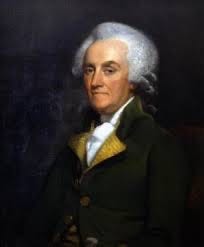
And to William, his son, once his closest companion, the boy he flew kites with, who became royal governor of New Jersey and stayed loyal to the Crown, he left some worthless Nova Scotia land claims and one sentence of ice: the part William acted against him in the late war would account for his leaving him no more of an estate that William had endeavored to deprive him of. Franklin never forgave him. The great conciliator, the man who charmed France into a war, could not manage one dinner of reconciliation with his own child. The one erratum he left uncorrected on purpose. Even the best editors have a page they cannot bear to reset.
Every museum label is an argument pretending to be a description. Franklin knew this before museums did. He spent sixty years setting his own type, casting himself first as the humble tradesman and later as the sage in the fur cap, and then he died and handed us the plates. We have been printing from them ever since.
I am not here to take the label down. The label gives you a saint of thrift who went to bed early. The object gives you a man who slept till ten in Passy, flirted an alliance out of a monarchy, forged widows and Algerians, skipped his own redemption arc until the last possible minute and then nailed it, and died still teasing the reader. He told us he was self-made, and he was right, just not in the schoolbook way. Franklin made Benjamin Franklin. It was his masterpiece, and he knew we would keep it on permanent display.
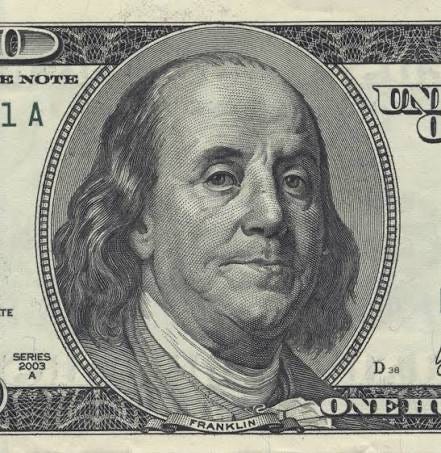
He is on the hundred dollar bill in a fur collar, looking mildly amused. He is still flirting with us. It is still working.
Banger as usual darlin!
Thank you.