
Before It Was a Masterpiece, It Was a Job

This essay started, as all things do, with a man online insulting Taylor Swift.
He was doing the bit. You know the bit. She is not a real artist. She is a corporate product, her records are content factories engineered for streaming, the Eras Tour is a Ponzi scheme in sequins, the friendship bracelets are merch. She is in it for the money, not the art, and any woman who cares about her writing is being conned by capitalism into mistaking a brand for a soul. He typed it with his whole chest, like he had discovered something the rest of us had failed to notice, namely that Taylor Swift’s career involves money.
What made the post interesting was not the insult. It was the assumption underneath. He was not arguing that her songs are bad. He was arguing that the presence of commerce disqualifies the work from being art. The corollary, unspoken because nobody has to speak it anymore, is that real art lives somewhere uncorrupted by money. Real artists are everything Taylor Swift is not, which is mostly to say they are not currently flying private to the Super Bowl.
He did not come up with this. He inherited it. The phrase that gives him permission to dismiss her as commercial has an author, a year, and a sales motive.
You have been sold a marketing slogan from 1835.
Picture the great artist alone in her cold garret, broke and compelled by something inside her that has nothing to do with money, slated for fame only after she dies. The same picture applies, with minor variations, to the great musician and the great novelist and the great indie filmmaker and the founder building the company in his garage. The picture is everywhere. It is the plot of Amadeus and the spine of every Wired profile and the moral arc of every Behind the Music special you have absorbed since. It lets you off the hook from thinking about labor, patrons, contracts, debt collectors, and the actual economic conditions under which beautiful things get made.
The picture is also almost entirely false.
Mozart wrote the Requiem on commission for a Viennese aristocrat named Count Franz von Walsegg, who paid Mozart to compose the mass so that he, the count, could pass it off as his own work for a memorial to his dead wife. The most spiritually loaded piece of music in the Western canon was vanity-publishing ghostwork for some grieving nobleman’s plagiarism scheme. Mozart died before he could finish it and his widow paid one of his students to complete it in secret so she could deliver it to the count and collect the rest of the fee. The Amadeus mythology has Mozart possessed by celestial transmission. The receipts have him chasing commissions, performing at private salons for cash, writing increasingly desperate letters to his friend Puchberg begging for loans. He died at thirty-five in financial precarity because his spending outran his income, not because the world failed to recognize him. The genius was the day job. Amadeus won eight Oscars pretending otherwise.
And it is not just music. Once you pull on this thread the entire fabric comes apart.
Girl with a Pearl Earring is not a portrait. We have spent four hundred years calling her mysterious because we want her to be a person with a name and a story and a forbidden glance, but she is none of those things. She is a tronie. A tronie is a Dutch market category, a stock character study painted on speculation, made for the open art market in seventeenth-century Delft and designed to hang in some bourgeois parlor owned by a buyer Vermeer had never met. The earring is probably glass. The model, if there even was one, is uncredited and probably interchangeable. The painting is inventory. The mystery is the marketing.
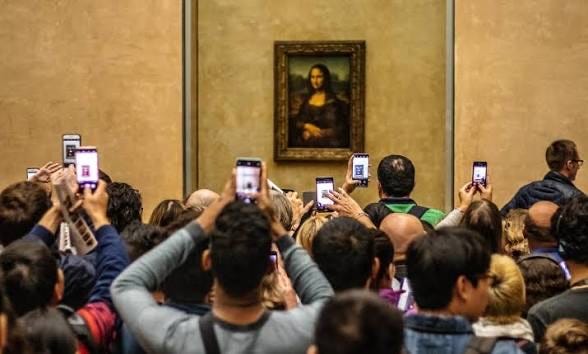
The Mona Lisa, five hundred miles south and a century and a half earlier, was never delivered to the family that paid for her. Leonardo accepted the commission from a Florentine silk merchant named Francesco del Giocondo to paint the merchant’s wife, and never handed her over. He carried her with him to Milan, to Rome, to France. He kept retouching her for sixteen years until he died with her in his possession in the Loire Valley, where the King of France acquired her one way or another. The most famous painting in the world was a stiffed commission. The smile you have spent your whole life decoding is the smile of a piece of merchandise that walked off the lot.
Bernini’s Saint Teresa is having a religious orgasm in the Cornaro Chapel. Head thrown back, mouth open, robes melting off her, an angel with a golden arrow poised above her chest. White marble lit from above like a stage. And the Cornaro family is in the chapel watching her. Six men of the Cornaro line, carved in stone, perched on what look like marble opera boxes set into the walls on either side of the saint, talking among themselves, pointing, leaning out with the proprietary lean of patrons admiring an investment. Because they paid for it. They paid for the chapel and the saint and the angel and the box seats and Bernini gave them everything they ordered. The most erotic religious sculpture in Western art is a real estate transaction with the donors physically present at the consummation. They paid to be the subject. Their faces are the receipt.
I think about these constantly. Whole industries have been built on the idea that what you are looking at is unknowable, transcendent, beyond commerce. They sell you the unknowability and bill you for the transcendence.
The phrase art for art’s sake sounds like it was carved over a museum door in the Renaissance. Théophile Gautier coined it in 1835, in the preface to a horny novel called Mademoiselle de Maupin, about a woman who cross-dresses as a man to find out what men are really like and sleeps with both sexes before vanishing. Gautier wrote the book partly to scandalize the bourgeoisie he was hoping would buy it. The defense of pure art was invented inside the market it claimed to reject. By a guy with a sex novel to sell. Every reverent wall label you have ever read, every survey course, every museum docent lowering her voice in front of a canvas, descends from a marketing slogan barely older than the daguerreotype.
Gautier was naming something real. The old patronage structures were collapsing in his lifetime. The aristocrats and popes and kings who had bankrolled centuries of European art were running out of money, going bankrupt, or losing their heads, and the artists who had spent generations as salaried specialists embedded in those courts and guilds suddenly had to make a living in a marketplace of strangers. Industrial printing exploded the audience. The academies wobbled. The job description for artist was being rewritten in real time, and the starving creator alone in her cold garret became imaginable precisely because the alternative, the artist as court employee or guild craftsman, was disappearing fast. The romantic myth was a real response to a real labor restructuring. It made sense in 1835. It makes considerably less sense now, when the conditions that produced the language have collapsed and the language has not, and we are still using nineteenth-century rhetoric to describe a twenty-first-century art market that has fully metabolized the rhetoric into its margins.
Once you see it you cannot unsee it. The invoices are the whole story.
Botticelli’s Birth of Venus was commissioned by the Medici as decorative panel art for a villa. The most reproduced female nude in Western art was glorified furniture, the Renaissance equivalent of a statement piece over the couch, made to flatter a banking family who wanted to associate themselves with classical learning because classical learning was the prestige play of the moment. Venus is rising from the foam to validate a wool merchant’s grandson’s social climb.
Michelangelo did not paint the Sistine ceiling because he had to. Julius II hired him. The contract specified the figures. He bitched about the job in letters to his family the entire four years and kept climbing the scaffold because he was getting paid. Caravaggio’s first Saint Matthew got rejected by the patrons for being too rough and he repainted it. What hangs in the Contarelli Chapel today is a Caravaggio with client notes. Velázquez was a salaried Habsburg employee who spent forty years painting whatever the king put in front of him, which was mostly the king’s weird inbred children, over and over, until he died on the payroll.
Holbein painted Henry VIII as a brand. The wide-stance, broad-shoulder, codpiece-forward image of the Tudor king you can summon from memory right now without trying was a piece of dynastic propaganda manufactured in Holbein’s workshop and replicated for distribution to ambassadors and provincial halls. There was a stencil. The face was a logo and so was the codpiece. Henry was an early adopter of image consulting and Holbein was his agency of record.
Rubens ran a corporate studio. He had employees with their own specialties in drapery, landscape, animal painting, and whatever else a commission required, and he priced his canvases on a sliding scale depending on how much of the painting was actually touched by his hand. The more Rubens, the higher the price. You could choose your level of Rubens like ordering a steak. This was a published menu. He was running a luxury goods business with tiered pricing for devotional objects and he died one of the richest artists in European history.
Hokusai’s Great Wave is a mass-market product. It was a woodblock print, one of dozens in a competitive series, mechanically reproduced for the Edo commercial print trade and sold to townspeople at popular prices. The Edo print market had its own collectors and tastemakers and price tiers, and the Great Wave was commerce inside that culture. The reverence we apply to it now is a Western projection that arrived a century after the fact.
David’s Napoleon Crossing the Alps is propaganda made on contract. Napoleon was never on a rearing horse on a mountain pass. He crossed on a mule, in foul weather, looking miserable. David painted what the regime needed and Napoleon weighed in personally on the pose. The painting is a press release. The horse is fictional, and so is the version of history you absorbed from it in textbooks.
Rembrandt died in debt. The inventory filed when he went bankrupt in 1656 runs to three hundred and sixty-three items because he had been speculating on prints and shells and weird imported objects like a guy trying to flip NFTs. Vermeer, who painted our girl, also died broke. His widow petitioned the city for bankruptcy relief in 1676 citing the collapse of the art market. Frans Hals died in poverty too, on municipal welfare, after a career of painting some of the most psychologically alive faces in Dutch art. The painters we treat as oracles of inner truth were all destroyed by the economy they were trying to game. The market did not exempt them because they were good. The market never does.
Joshua Reynolds founded the Royal Academy in 1768 to do for English painting what a chamber of commerce does for a town: fix prices, gatekeep entry, manufacture credentials. He was a guild organizer in a powdered wig. A century later Sargent perfected the function in oil, painting robber baron daughters in dresses that cost more than most people earned in a decade. Every Madame X you have ever swooned over was somebody laundering new money into old prestige through canvas.
Gilbert Stuart kept the Athenaeum portrait of George Washington deliberately unfinished. He blocked in the famous face and left everything else blank because he needed to keep using it. He called the replicas he produced from it his hundred-dollar bills and turned out more than seventy versions over the course of his career, selling to anyone who could pay. When he died his daughter inherited the operation and kept the copies coming for decades. The face on the one-dollar bill, the most reproduced face in American history, was a family side hustle with inventory turnover.
The Impressionists, the patron saints of the misunderstood-genius mythology, were a business. Paul Durand-Ruel bought their work cheap when nobody wanted it, opened galleries in New York, cultivated American collectors with new industrial money looking for European cultural legitimacy, manufactured scarcity, and made all of them rich. Himself richest of all. Monet became Monet because he had a dealer with a good network. The Salon des Refusés did not become a movement on its own. It was branded into one.
The Mona Lisa, by the way, was not particularly famous until 1911, when an Italian handyman walked her out of the Louvre under his smock and triggered a two-year international press cycle that made her face the most recognizable image on earth. Before the theft she was a Leonardo. After the theft she was the Mona Lisa. The fame is also marketing, just retroactive. The Louvre figured out fast that the empty wall where she used to hang was drawing bigger crowds than the painting itself had. They left it empty for a while.
Picasso understood the whole apparatus earlier and better than any of his peers. He negotiated his own contracts and played dealers against each other like horses he was running at the track. He hoarded his own work because he knew his estate was the long bet. By the time he died in 1973 he had structured his career like a hedge fund and left behind one of the largest private collections of his own paintings in history. The estate is still litigating. The art was never separable from the asset class. He just admitted it earlier than the museum world was ready to hear.
Warhol said it out loud. “Business art is the step that comes after Art.” He knew the mystique of purity was itself the most expensive product in the room and selling the mystique was the move. Koons was a commodities trader. Hirst sold a shark in formaldehyde to a hedge fund manager for twelve million dollars. Then he diamond-encrusted a human skull, listed it at one hundred million dollars, and sold it to a syndicate of investors that turned out, quietly, to include himself and his gallerist. Read that again. He bought it from himself. The press wrote about the unbelievable value of his work. The price held. The transparency loops back around into honesty. Banksy shredded a painting at auction the moment it sold and the shredded painting immediately doubled in value, the cleanest demonstration in living memory that destruction is just another marketing channel when the brand is strong enough. The market doesn’t even pretend anymore. The pretense is the upcharge.
So why does the myth persist. Because everyone in the room needs it. The artist needs to believe her compulsion is sacred or she could not get out of bed. The collector tells himself he is buying transcendence because it sounds better than admitting he is parking money in objects insured against inflation. The dealer protects the mystique because mystique is the margin. The novelist clings to the idea that her book is the work of her soul and not a deliverable to her publisher. The musician wants the song to have come to her in a dream and not from a co-writing session engineered around streaming royalties. The founder calls the company a mission instead of a fundraise. Every creative economy in the world runs on the same lie because the lie is more flattering than the contract. Nobody in the room is going to be the one to say the contract out loud.
And the museum. God. The museum. The museum is where the laundering gets sanctified. The wall label gives you the artist, the date, the donor’s name, and nothing else, and you walk past the donor’s name without registering it because you have been trained to look at the art and not at the apparatus holding it up. The Sackler wing. The Koch theater. Every wing named after every fortune ever made off something the label will never mention, the painkillers and the petrochemical lobbying and the union-busting and the labor of people whose faces are not in any portrait in any wing of any of these buildings, all of it scrubbed and engraved into marble at the entrance and transmuted into the aura of philanthropy by proximity to oil paint. The hush in the gallery is not reverence. The hush is so you do not ask questions.
Walk into any museum and try this. Read the donor name first. Then read the artist. Then ask what the donor did for money. Then ask what the artist did for money. Then ask who modeled for the painting and what she got paid and whether she got paid at all. The label will not tell you. The label is part of the brand.
Mozart’s Requiem is still playing at funerals. Girl with a Pearl Earring is still in the Mauritshuis, looking at you the way Vermeer engineered her to look at you, which is to say the way a piece of speculative seventeenth-century inventory was designed to make a buyer feel chosen. The Mona Lisa is still behind bulletproof glass at the Louvre with a velvet rope and a crowd, and her smile is still doing the same job it was doing when Leonardo refused to hand her over. Saint Teresa is still mid-rapture in the Cornaro Chapel with her patrons still leaning out of their marble opera boxes to watch the rapture they paid for. All four of them are doing exactly the work they were made to do, on the schedule the contract specified, for the buyer who paid the bill. You are the one who keeps deciding to call it something else.
Taylor Swift made two billion dollars on tour because she is good at her job. Rubens ran tiered pricing on devotional paintings until he died one of the richest men in Europe. Bernini carved the Cornaros their orgasm in marble for cash. Mozart died ghostwriting a count’s plagiarism scheme. They are all doing the same job. The man online thought he was insulting Taylor Swift. He was quoting Gautier without knowing he was quoting Gautier.
Nobody whose name you know was doing this for free. Nobody is doing this for free now. The art is the merchandise, the myth is the markup, and the hush in the gallery is the sales pitch you have been mistaking for reverence. The only people who benefit from you not seeing that are the ones still selling it to you.
I was just talking about this with a buddy who plays in an orchestra. Mozart is held as this paragon of classical music and of course his brilliance can’t be brushed aside. But listen to any playlist of his music and the vast majority of it is chamber music commissioned for wealthy dinner parties
Emma ... why don't you just say what you really feel about all this .... 🦋
(sorry, I love to banter)