
Alexander the Pretty Good

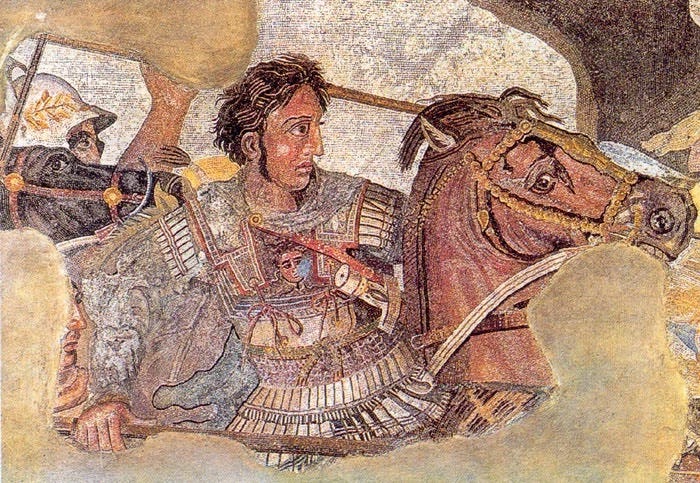
Alexander Mosaic, Roman copy of a lost Hellenistic painting, c. 100 BCE. National Archaeological Museum, Naples.
Let me be fair to Alexander before I take him apart, because the man earned it and almost nobody bothers.
He was good. Annoyingly good. He never lost a major battle in a whole career of them, which should be statistically impossible, and he pulled it off against bigger armies, on ground he had never seen, making it up as he went in ways they still diagram in war colleges. He took Persia. He took Egypt. He walked an army to the edge of India because a map having an edge apparently felt like a personal insult. The talent was real and the nerve was real and I am not going to sit here and pretend the men who followed him across the known world were idiots for wanting to. I get it. On paper he is the most impressive person who ever lived.
Which is the problem. Because I rate him this highly, you do not get to wave me off as some hater who never gave him his due. I gave him his due. I gave him the whole paragraph. And it is precisely because he was that gifted that the rest of this is so damning, because talent that big does not get to plead incompetence for the part that actually mattered, the part that comes after the fighting stops.
Because look at what all that genius built to keep the empire whole. Nothing. The thing itself could not outlive him by a decade.
The empire was the largest the ancient world had ever seen, and it lasted, as a unified entity, approximately as long as Alexander's corpse stayed warm. And before the swoon gets going, the army that won it was not even his design. He inherited the best military machine in the world from his father, Philip II, who spent his whole reign professionalizing the infantry, building the tactics, and bringing most of Greece under Macedonian control so his son wouldn't have to. Philip did the unglamorous work and got assassinated for it, and his 20-year-old son inherited a loaded gun and pointed it east. That takes nothing away from how well he aimed. It just means the man half the internet treats as a self-made colossus was handed the company by his father and took full credit for the quarterly numbers.
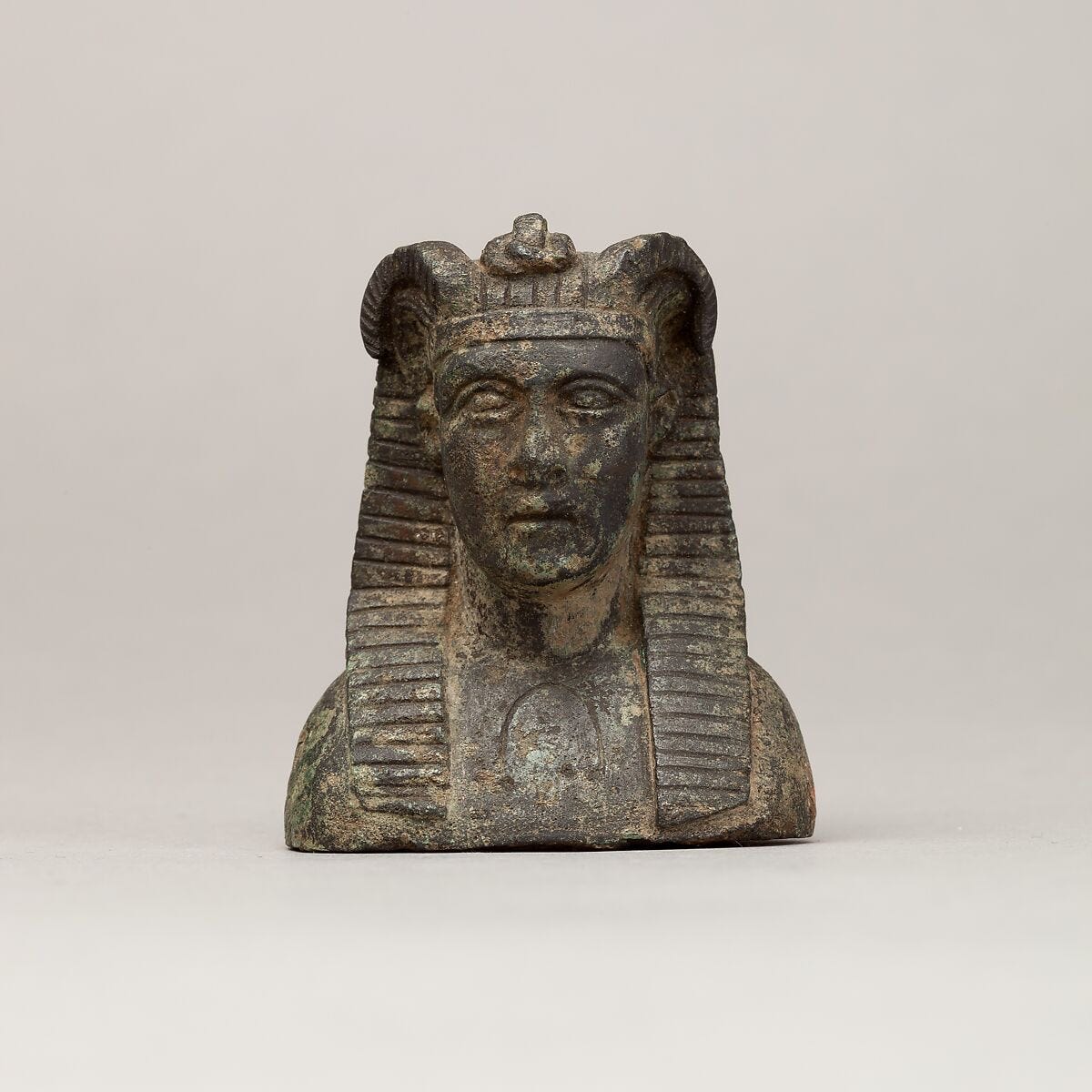
Bust of Alexander as Pharaoh, copper alloy, c. 150 BCE-AD 200. The Metropolitan Museum of Art, New York.
He died in Babylon in June of 323 BCE, most likely of a fever, possibly of the drinking, and when his generals asked him on his deathbed who should get the empire, this master strategist, this once-in-a-species genius, looked at the single most important question of his entire life and said, according to the most famous tradition, "to the strongest." That's it. That's the succession plan. A man who could coordinate a cavalry charge across a battlefield he'd never seen could not be bothered to write a will. Read that again. He left the greatest empire on earth to whichever of his friends could kill the others fastest, and then he died, and they did exactly that.
The body didn't even get buried on schedule. While the man was lying there decomposing, his generals were already at each other's throats, and one of them, Ptolemy, literally stole the corpse and drove it to Egypt as a trophy, because possessing Alexander's dead body was worth more as a legitimacy prop than anything Alexander had actually planned for. That's your great man. A carcass in a hijacked funeral cart, being used as a mascot by the guys who are about to spend forty years murdering each other over the stuff he never organized.
Let's do the family, because this is where I stop laughing. Alexander left a pregnant wife, Roxana, and no adult heir. Within a few years, everyone connected to him by blood was dead, and not one of them of natural causes. His half-brother Philip III, installed as a puppet king, murdered. His mother, Olympias, murdered. Roxana, murdered. His son Alexander IV, the actual heir to the actual empire, held prisoner as a child and then quietly killed around age 13 by a general named Cassander who decided a living heir was inconvenient. His other reputed son, Heracles, also killed. The entire Argead bloodline, a dynasty that had ruled Macedon for centuries, wiped out within about two decades of Alexander's death, because the man built a machine so dependent on his personal presence that the moment he was gone it turned on everyone he loved and ate them.
And I want to be careful here, because the next part is the one people get wrong in both directions. Alexander loved Hephaestion. His companion since boyhood, his second in command, and by any serious reading one of the great loves of his life. The men-loving-men part is not the joke and never will be, not from me. His world did not sort desire into our modern categories, and the guys clutching pearls over it are bringing far more anachronism to the table than any drag queen who ever claimed him. If anything it is the most human thing on his whole resume. Hold that thought, though, because of what he did with it.
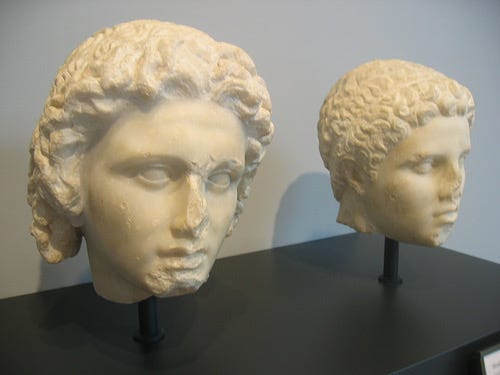
Heads of Alexander and Hephaestion, Roman copies after Hellenistic originals. Archaeological Museum of Pella, Greece.
When Hephaestion died of a fever in 324, Alexander came apart, and I mean administratively. The sources say he lay on the body for a day and would not be moved. He refused food. He had the man's doctor executed. He ordered the manes and tails of every horse and mule in the army shorn in mourning. He tore the battlements off the surrounding cities. He banned music. He asked the oracle of Ammon for divine honors, and when the answer authorized a hero cult instead of godhood, he built the shrines anyway. He refused to name a new commander for Hephaestion's cavalry so the regiment would carry a dead man's name forever. Look at all that. Look at the sheer logistical follow-through. This is a man capable of moving an empire to honor a feeling.
He just never once moved it to answer the only question that would have kept everyone he loved alive. He could organize the worship of a corpse and could not organize a succession. He had an army's horses shorn over a fever and left his pregnant wife and unborn son to be murdered by the men in the room. The devotion was real. It was simply never, not for a single afternoon, pointed at the future. He felt enormously and planned nothing, and both of those are the same man.
That is the legacy. Not an empire. A power vacuum with his name on it. By the time the dust settled at the Battle of Ipsus in 301, the map was carved into pieces run by his former subordinates, and it would never be one thing again. He spent his whole life acquiring and left nothing that could hold. He was a man who could take anything and keep none of it. The world's greatest conqueror was, functionally, the world's greatest impulse purchase.
And yes, before someone types it in the comments: Hellenistic culture reshaped the Mediterranean for centuries after him. Greek language and Greek cities and the whole long cultural fusion that ran from Egypt to the edge of India. That's real, and it's genuinely his. But that isn't the achievement his admirers are celebrating when they put him on the shelf. Nobody's crying into their protein shake about the diffusion of Koine Greek. They're worshipping the domination, the man who took the world and made it look easy. And that world detonated the second he stopped breathing.
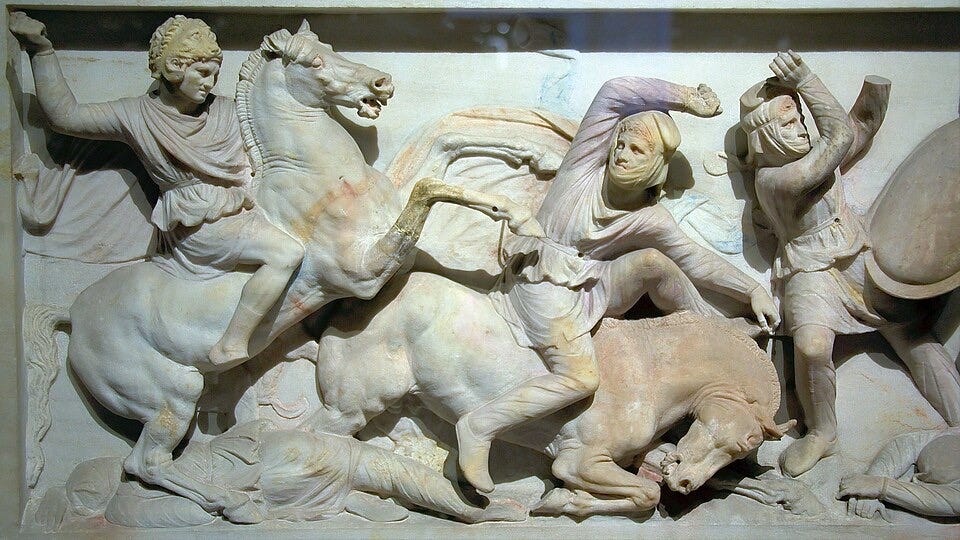
Alexander Sarcophagus (detail), marble, c. 320 BCE. Istanbul Archaeological Museums.
Now. The fans.
There is a reason a certain kind of man needs Alexander to be the greatest human who ever lived, and it is not historical. It's aspirational, and the aspiration is telling on itself. This is the patron saint of every guy who has ever done a cold plunge and called it discipline, and he is drawn to a story about a young man who dominated the entire known world through sheer will and never had to sit in the aftermath. He gets to skip the boring parts, the governance and the maintenance and all the slow unglamorous work of making a thing last past you. Just domination and glory and a conveniently early death that means he never had to be accountable for the wreckage. It is the great man theory of history for men who have never had to clean anything up.
Watch what they quote. Never the administration. Never the logistics, which were, to be fair, genuinely impressive, the actual skill Alexander had. They quote the crying about no more worlds. They quote "fortune favors the bold." They want the aesthetics of conquest with none of the responsibility of the day after, which, if you think about it for four seconds, is the exact psychological profile of the man himself. Alexander stans are not misreading him. They are perfectly, precisely reading him. They love a man who could win everything and secure nothing because deep down that's the fantasy: to be admired for the taking and excused for the losing.
He was 32. He was brilliant at the one thing and criminally negligent at everything that came after it. He conquered the world and could not keep it intact for a single week past his own heartbeat, and his reward is that three thousand years later he is the emotional support historical figure of men who confuse acquisition with achievement.
The most powerful man in the ancient world couldn't name a successor. But sure. Put him on the shelf.
Except he wants to say something. He’s been dead for 2,300 years and he has notes. Fine. Let him talk.
Okay. First of all. Rude.
Second of all, half of what you just said is true and you know it, so let me have my moment. You want to talk about the army I inherited from my dad? Fine. I did inherit it. You know what most people do with a good inheritance? Lose it. I took the best army in the world and I did not blow it, I compounded it. I beat Darius at Gaugamela when he outnumbered me maybe five to one. I took Tyre by building a causeway into the sea because the city sat on an island and thought that made it safe. Nobody handed me the Gordian knot with a solution attached. I made my own. So yes, thank you Philip, love you dad, but do not act like the trophy just fell into my lap. I earned the map.
And the logistics? You said it yourself, buried in your little takedown. I moved an army thousands of miles across deserts and mountains and kept it fed and paid and loyal for a decade. Do you know how hard that is? People write dissertations on my supply lines. I founded cities. Dozens of them. One of them was Alexandria, which, and I don’t want to brag, became the intellectual capital of the entire Mediterranean world for centuries. The Library? The Lighthouse? That’s my zip code. When was the last time anything you founded outlived you by seven hundred years?
And I didn’t do it from a tent in the back. That’s the part that gets me. I led from the front. Every siege, every charge, I was there, which is why I’ve got the scars and the limp and the lung they punctured with an arrow in India. Ask me how many of the men who idolize me have ever been first over anything. I bled with my army. I was first over the wall. I took the arrow. When Bucephalus died I named a city after him, because that’s who I am. I’m loyal. I feel things. I…
See, this is the thing you moderns don’t get about greatness. You want it clean. You want the man who conquers the world to also file the paperwork and set up the pension plan and leave a tidy little constitution behind. But that’s not how it works. Some men are built to take. That’s the gift. That’s the whole…
okay and honestly the succession thing gets so overblown, I said “to the strongest” because I trusted my men, these were my brothers, we bled together, and if they couldn’t sort it out like adults that’s a reflection on them, not me. okay they did murder my entire family, that’s fair, that happened, but that’s on them, that’s a them problem, I was dead, what was I supposed to do about it, and also for the record Roxana was pregnant when I died so it’s not like I had a grown son sitting right there ready to take over, the timing was genuinely bad, and I was 32, I had time, nobody plans to die at 32, do YOU have a will? at 32? no? exactly, so maybe get off my case about the estate planning when you haven’t even…
and leave Hephaestion out of it. you don’t get to use him. you have no idea what it was, nobody does, I gave him a funeral a god would envy, I made them worship him, I burned down half a skyline for him because that is what it looks like when I love something, that is the receipt, so do not stand there and tell me I don’t follow through, I followed through on HIM, I moved the whole world for him, I just… I could do that for a dead man and not for a…
…okay.
and you know what, the crying quote isn’t even real, you SAID it isn’t real, so you don’t get to use it against me AND admit it’s fake, pick one, that’s not fair, that’s bad faith, that’s exactly the kind of thing. and while we’re at it the Gordian knot was a LEGITIMATE solution, everyone acts like cutting it was cheating, the oracle said whoever undoes it rules Asia, it didn’t say HOW, I undid it, I ruled Asia, checkmate, that’s not impulsive that’s lateral thinking, that’s…
…
Okay that got away from me a little.
And there it is. He almost had me. That's the thing about Alexander, he's genuinely good in the room, and for a few paragraphs you remember why men have been falling for this for two thousand years. The causeway at Tyre is real. The logistics are real. Alexandria really did outlive him by centuries. And the part about leading from the front is not just real, it's the most honest thing he says. He did bleed with his army. He was first over the wall. He took the arrow. Give the man his due, all of it. He was not stupid, he was not lazy, he was not a coward, and the conquering was not luck.
But watch what happened the second the subject changed. The moment we got off the battlefield and onto the aftermath, the charm sped up, the sentences ran together, and the greatest strategist in history started sounding exactly like every man who has ever explained why the thing that fell apart wasn't his fault. It's on them. It's a them problem. I was dead, what was I supposed to do. Do you have a will. He conquered Persia and his closing argument is that you, personally, are also probably not estate-planning correctly.
And that reflex is the whole thing, more than the failure ever was. A man who could adapt to any battlefield in the world could not, even with 2,300 years to think about it, do the one thing that actually separates a conqueror from a builder: look at the wreckage and say I should have handled that. And notice where he finally cracked, because it wasn't the empire. It was Hephaestion. He can talk about the succession like a man reading a hostile performance review, all deflection and reflex, and then you say one name and the real thing falls out of him. He could move heaven and earth for a person he loved. He proved it. He had an army's horses shorn over a fever. Which means the failure was never that he couldn't follow through. He could. Spectacularly. He just decided the future was not worth the effort he'd spend on a funeral. He would rather cut the knot than untie it. He would rather be brilliant and blameless than accountable and alive. He would rather grieve like a god than govern like an adult.
Was Alexander great? Of course he was. That was never the question.
The question is what he was great at. And the answer is taking. He was the best taker who ever lived and he could not build a single thing strong enough to hold what he took. Not the empire. Not the bloodline. Not the people who loved him.
Three thousand years later, men still say his name to make acquisition sound like achievement. To make winning sound like the same thing as keeping.
Put him back on the shelf. He is exactly where he belongs. Small, cast in bronze, and finally holding still.
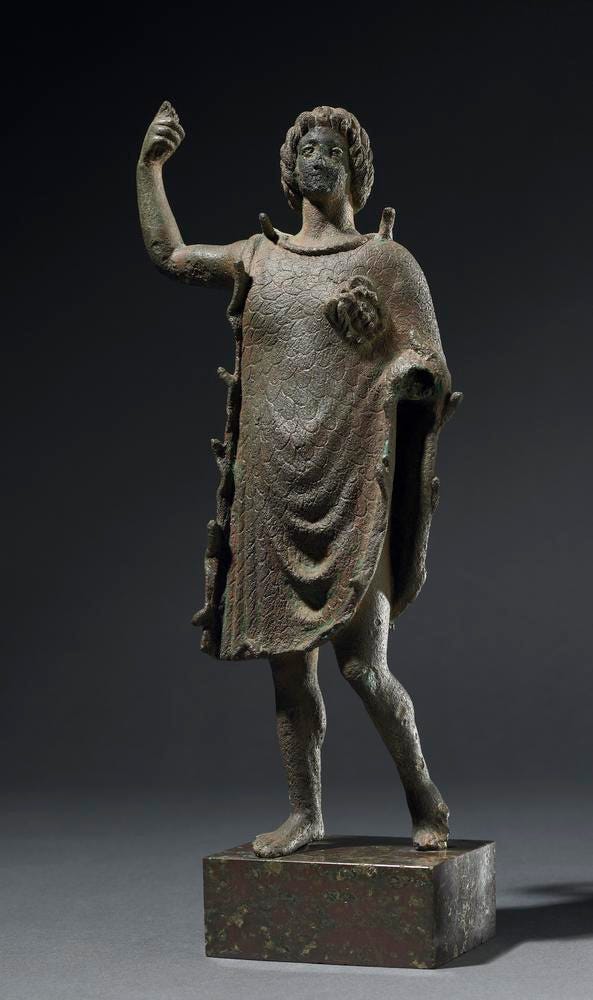
Statuette of Alexander the Great, Roman copy of a Hellenistic original, 1st century CE. Bronze. British Museum.
That's an epically insightful take. Give Roman Emperor Augustus his due - although he led from behind and reportedly had little military talent, his improvised, craven, thinly disguised kingship without formal succession lasted hundreds of years.
In light of yet another English loss, I’ve been thinking a lot about the British Empire lately and how they were able to hold itself together for about 400 years.
Was there a single Alexander-like figure? Nope.