
1787 Lafitte Th.J
The most expensive wine ever sold: the Jefferson bottles.

In December 1985 a bottle of red wine sold at Christie's in London for more money than any bottle of wine in history.
It was dark green glass, hand-blown, plainly old. Someone had engraved it: the year 1787, and the word Lafitte, and the initials Th.J. In the 1780s Lafite was the wine of the French court, served at Versailles, poured for Louis XV, the bottle you put in front of a king to prove you had taste and money in equal measure. Two and a half centuries later it is still one of the most famous and expensive red wines on earth. Michael Broadbent, the most respected wine authority alive, ran the sale himself and vouched for the bottle. The hammer came down at £105,000, about $156,000. For one bottle. Malcolm Forbes bought it, and the record stood for years.
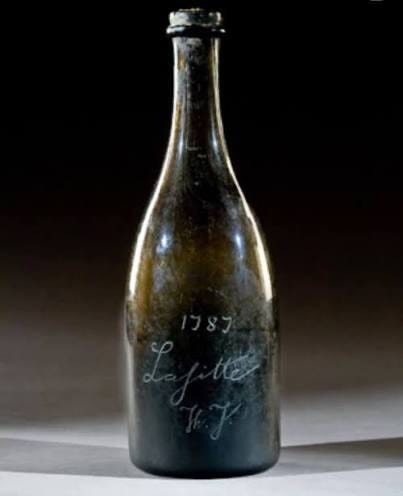
Nobody in that room thought they were buying wine. The liquid inside had been vinegar since before the French Revolution. They were buying the engraving, and the engraving was a claim. Th.J was Thomas Jefferson. In the 1780s he was America's man in Paris, the new country's minister to France, and he was also the most serious wine obsessive the young republic ever produced. The bottle had come from his own cellar. That was the whole value. Not the glass, not the dead wine. The name.
And it was a glorious thing to believe, because the story behind the bottle was perfect.
The man who found it was a German collector named Hardy Rodenstock, and in the early 1980s he told the wine world he had made the discovery of the century. Workers in Paris, he said, had knocked through a bricked-up wall in an old cellar and found a hoard of eighteenth-century Bordeaux that had been sealed up and forgotten behind it. Roughly a hundred bottles. Several of them engraved with the initials Th.J. And the cellar sat in the very part of Paris where Jefferson had lived.
That last detail is what made the whole thing sing. Jefferson really had been in Paris in those exact years, really had loved Bordeaux above almost anything, really had bought it by the case. A cache of his old bottles surfacing in his old neighborhood was not far-fetched. It was the most romantic thing that could possibly happen to a wine collector, and it had apparently just happened. Of course they believed it. They wanted it to be true, and at first glance there was no reason it couldn't be.
None of that is wrong, exactly. Jefferson is worth wanting. That is the problem.
Jefferson learned wine the hard way, by getting robbed. He once ordered a great Bordeaux estate and got sent something lesser in the same bottles, a cheaper wine wearing a grander name. This was normal for the age. Wine traveled through a long line of merchants, and any man in that line could water it down, blend in something cheap, or peel off a label and stick on a better one. Taste was the only defense. The label told you nothing, because the label was the easiest thing in the world to fake.
Jefferson took the lesson and built his life on it. Stop trusting the middlemen. Buy from the estate that grew the grapes, and the line of liars vanishes. That was the rule for the rest of his life. Hold onto it, because it is the exact thing that gets turned against him two hundred years later.
Buying at the source means knowing the sources, so he learned them the way other men learned scripture. In 1787, living in Paris, he vanished for three and a half months and three thousand miles through the wine country of France and northern Italy. He kept a journal stuffed with notes on which soils and which growers produced the wine worth having. Five days in Bordeaux alone.
Then he ranked the great estates himself, by taste, and put a handful at the top. Most people take a long European trip and come home with sketches and regrets. Jefferson came home with a ranking of the best chateaux in Bordeaux that still basically holds today, decades before the French got around to making it official. He tasted the answer before the industry agreed on it.
The obsession came home with him. Bottles arrived at Monticello by the hundreds, on top of the hundreds already there. He built a dumbwaiter into the dining room wall so a fresh bottle could ride up from the cellar without a servant breaking the conversation. Hamilton mocked him for going so French he had abandoned plain American tastes. It was a snob calling a snob a snob. It was also true.
So the initials on that bottle did not belong to some Founding Father who liked a drink. They belonged to the most credible wine authority in American history, a man whose whole philosophy existed to keep him from being fooled by a bottle. That is why his name on old glass was worth a fortune. Owning a bottle from Jefferson's cellar meant owning the personal property of the patron saint of wine.
And here is where I have to be honest about the thing I find genuinely strange, which is the wanting to own it at all. I work with old objects. I love them past the point of reason. But I have never once needed to take one home, because the love was never about possession. I want the thing preserved. I want it kept where people can stand in front of it and feel the centuries close up. Everyone assumes that because I adore the past I must want to hoard a piece of it, and I do not, and I find the people who do a little bit fascinating and a little bit unwell. Collecting at this level is not preservation. It is the urge to make a dead thing personal property, to point at a relic and say mine. Nobody who paid six figures for a Jefferson bottle was going to drink it or study it. They wanted to own Jefferson. That is the whole psychology the con ran on, and it has nothing to do with wine.
Which is exactly why nobody wanted to look too hard at the man who found it.
Hardy Rodenstock had the kind of biography that gets more concerning every time another sentence gets added to it. The name was invented. He had been born Meinhard Görke and worked in German pop music before he reinvented himself in the rare wine world. By the 1980s he was the man who found the unfindable, the collector who could always produce a legendary bottle nobody else could locate, who poured wines at his tastings that most people would never taste once in a life. A man who keeps turning up impossible bottles is either the luckiest collector alive or the most enterprising. The wine world chose to call it luck.
And it chose not to ask the obvious questions. Which building in Paris held the cellar? Rodenstock would not say. Who had found the bottles, who had called him, could anyone go and see the wall? He had never been to the building himself, he said, and would not name it. How many bottles were down there to begin with? He would not say. The most valuable wine on earth rested on the word of a man with a stage name, and the man would not explain himself. The people holding the most exciting bottles they had ever been offered looked at all of this and decided not to push.
The proof was sitting in the open the whole time. They just looked at the wrong things.
Christie's did not skip the homework, which is the part that should sting. Their glass experts confirmed the bottle was period, genuinely old. An expert from the British Library examined the lettering and confirmed the engraving style looked right for the era. Both of those things were true. The glass really was eighteenth-century, and the script really did look the part. But looking right and being possible are different questions. Nobody in 1985 tried to carve those letters with eighteenth-century tools to see if it could even be done, which is the test that eventually broke the case twenty years later. They confirmed the bottle was old and the lettering was pretty. They never confirmed the one thing the entire price depended on, which was whether any of it had come within a mile of Thomas Jefferson.
The people who checked the man were at Monticello. Jefferson's records are nearly complete, every wine order logged like the weather across tens of thousands of letters and account books. The researchers searched for the cache. Nothing. No order for the 1787 vintage that made up most of the bottles. Then they caught the thing that ends the entire story on day one.
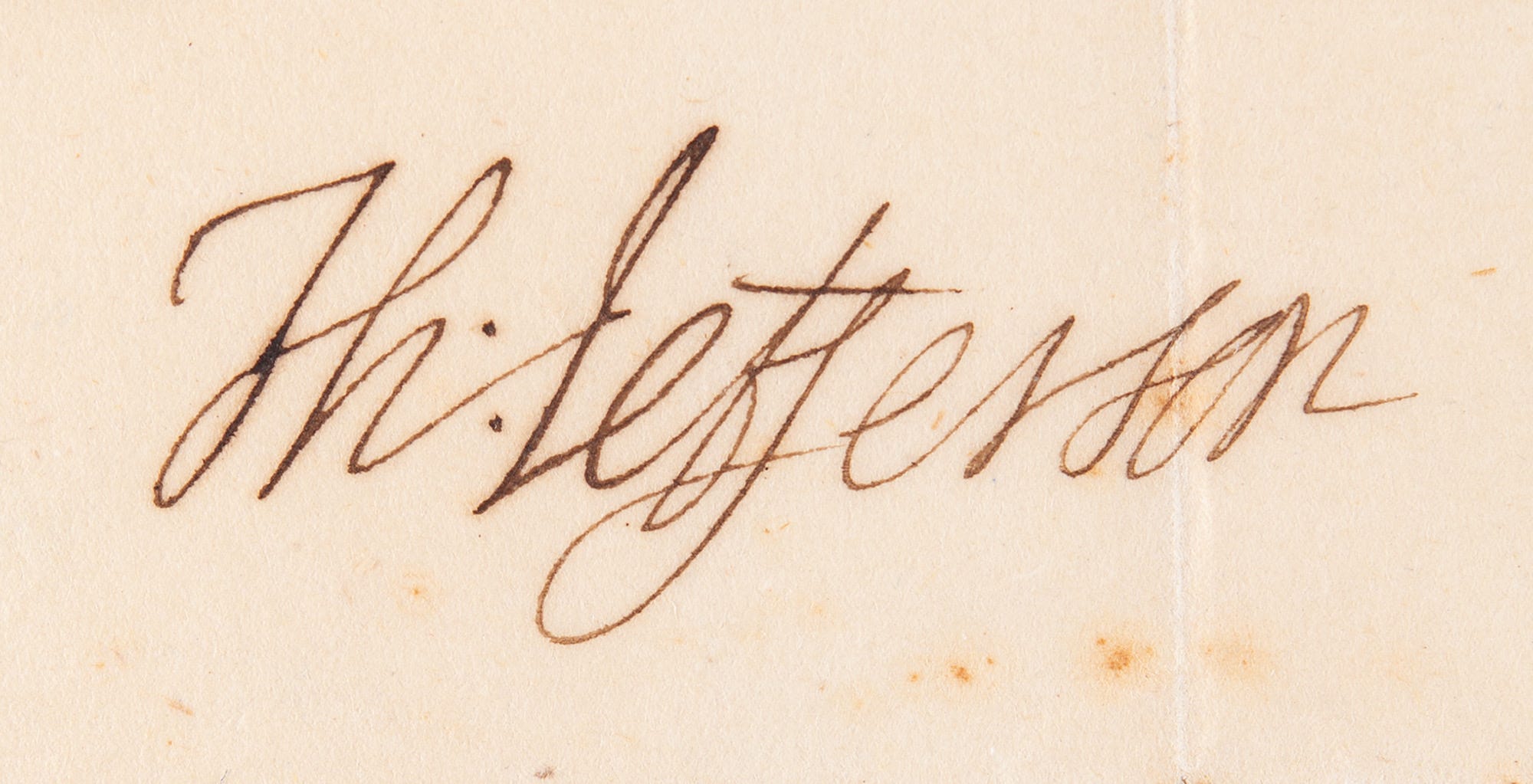
Jefferson never wrote "Th.J." He signed "Th: Jefferson," colon, full last name, every time, thousands of times across his life. The bottle from his own cellar got his own signature wrong. A forger grabbed the most obvious shorthand for Jefferson he could picture and cut initials the real man never used, and a room of experts looked straight at the error and saw a Founding Father, because that was what they came to see. The British Library had vouched for the elegance of the lettering. Nobody checked it against a single thing Jefferson actually wrote. The most basic possible step, hold the bottle next to a real Jefferson signature, was the one step that would have ended the dream, so nobody took it.
Monticello said so. Broadbent waved it off. He had bet the biggest sale of his career on these bottles, and a man who has hoped that hard does not want to hear from a historian in Virginia.
The doubt sat for twenty years. A billionaire broke it, because he would rather be right than admired.
Bill Koch is an oil-and-chemicals heir, the twin brother of David Koch and the third of the famous Koch brothers, the kind of rich where buying things is a personality. In the late 1980s he paid around half a million dollars for four of the Jefferson bottles. Sit with that. Half a million dollars for four bottles of two-hundred-year-old vinegar nobody was ever going to drink, and to him it was an ordinary afternoon. He owns something like fifteen thousand bottles. He collects the way other people breathe. The Jefferson four were going to sit in a case as proof he owned a sliver of a Founding Father, and that was the entire point.
Then he decided to put them in an exhibition, and the museum did the one thing nobody in the wine world had bothered to do in twenty years. It asked him to prove where they came from. He went to confirm the provenance, and Jefferson's estate could not back it up. That tiny bureaucratic dead end was the loose thread, and Bill Koch was the single worst person on earth to hand a loose thread, because being maybe-conned did not make him sad. It made him furious. He did not want to gaze at the relic anymore. He wanted blood. He hired a former FBI investigator, who built a team that reportedly included a former Scotland Yard detective and a former MI5 officer, and pointed an actual intelligence apparatus at a wine bottle, because a man that rich does not get embarrassed quietly. He gets embarrassed with a budget.
Koch's investigators did not find one fatal problem. They found the kind of problem that multiplies the longer you look at it. The engraving had been cut with a rotary power tool that did not exist in the eighteenth century. The wine inside tested as having been made before 1945. A later analysis dated some of it to around 1962. A disgruntled landlord, after Rodenstock was evicted from a property, found the rest of the story in a basement: a stack of unused blank wine labels, a pile of corks, and a few dozen empty antique bottles lying next to a dirt-covered carpet he had apparently been rolling the bottles in to age them. Koch sued and won a judgment of over a million dollars that Rodenstock, who refused to even appear, has never paid a cent of. Koch spent something like a million dollars on the investigation to claw back the half-million he had handed over for vinegar, then kept going, turning the rest of his life into a war on wine fraud. The bottle had survived collectors, auction houses, and the finest palates in the world. The dangerous person turned out to be the one rich guy too petty to let it go.
None of it had ever been hidden. The tool marks were on the outside of the glass. The wrong initials were legible to anyone who had read one letter in Jefferson's hand. Jefferson documented his life so obsessively that historians can tell you what wine he ordered in a given year and what he paid for it. The bottle turned up exactly where the paperwork should have been, and the paperwork was never there. Every clue that cracked the case sat in the open in 1985. The bottle in 2005 was the same bottle it had been in 1985. The only thing that had changed was that the room finally contained one man who would rather catch a liar than own a Founding Father, and it turned out that was all the case had ever needed.
As for the famous bottle, the record-setting Lafite, it never even made it to a verdict. Forbes put it on display in his gallery on Fifth Avenue, under lights, the way you show off a thing you own. The lights warmed the glass. The ancient cork dried out, shrank, and slid down into the wine. So the most expensive bottle of wine in history was killed by a man wanting to look at it. Nobody made that happen but the owner, and he did it for the worst possible reason, which was to be seen having it.
That is the whole answer. Jefferson built his life on one idea, that a bottle will lie to you, and the only defense is to go to the source. The con that made him its mascot ran that idea in reverse, selling a beautiful story about a bottle to people who wanted the story more than the wine and never went to the source at all. The most careful wine buyer in American history became the bait for the least careful, a room of experts who paid a record price without checking a single letter of the name. They wanted him so badly they forgot the one thing he knew. Go to the source. Otherwise the bottle tells you exactly what you came to hear.
This was fantastic, the paragraph about not understanding WHY you'd want to own something that old was really radiant compared to the seedy underbelly of the rest of the story
There seems to be a few bottles of pre-French Revolutionary liquors floating around. The Donovan Bar in Mayfield, London has the world's most expensive cocktail at 7,500 pounds with cognac from 1788. Too rich, even for a king!